A life in context
The person behind the prize
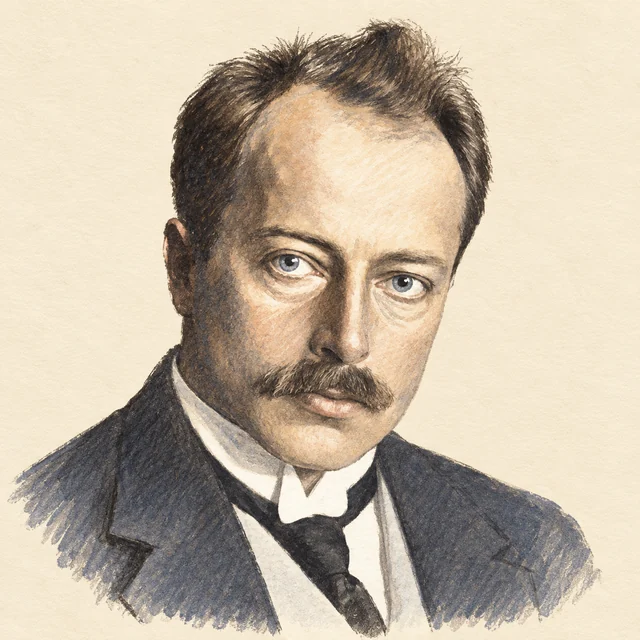
Max von Laue grew up in several German cities and studied at Strasbourg, Göttingen, Munich and Berlin. A doctorate under Max Planck in Berlin in 1903 led to work on radiation, interference and thermodynamics. He became Planck’s assistant in 1905 and moved to Munich in 1909. There he proposed that a crystal’s regular atomic arrangement could act as a natural diffraction grating for X-rays. Walter Friedrich and Paul Knipping performed the experiments in 1912, obtaining patterned spots on photographic material. Laue developed the theoretical interpretation. The result supported the wave character of X-rays and opened a route to investigating crystals. He was the sole recipient of the 1914 Physics Prize, but the experiments were a collaborative achievement. The award was announced on 11 November 1915. He had moved to Zurich in 1912 and Frankfurt in 1914; Frankfurt is the affiliation recorded for the award, while the discovery was made in Munich. A Berlin professorship followed in 1919. His wider work included relativity, X-ray optics and superconductivity. Under National Socialism, he defended scientific work attacked on antisemitic grounds and maintained contact with Jewish and emigrated colleagues. After the war, he helped rebuild German research and worked at the Fritz Haber Institute. He died in Berlin in 1960 after a road collision.
The contribution
Laue received the full Physics Prize for discovering diffraction of X-rays by crystals. He proposed the use of the crystal lattice and developed its interference theory; Friedrich and Knipping carried out the experiments that established the patterned diffraction.
The idea in plain language
The nature of X-rays was still debated. If their wavelength was extremely short, an ordinary optical grating would be too coarse to reveal a clear diffraction pattern. Laue recognised that the repeating arrangement within a crystal could provide a much finer natural grating. He developed a theoretical account of how scattered waves could reinforce in particular directions.
Read the full award story ↗

