c.curionodeThe Nobel Archive

1915 · Physics

Infer crystal structure from X-ray diffraction

The Braggs turned diffracted X-rays into a way of investigating atomic arrangements. Lawrence’s geometry and William Henry’s instruments and measurements connected a pattern outside the crystal to structure within it.

X-raysCrystal structureDiffraction
1915Physics

Visual guide

The prize, pictured

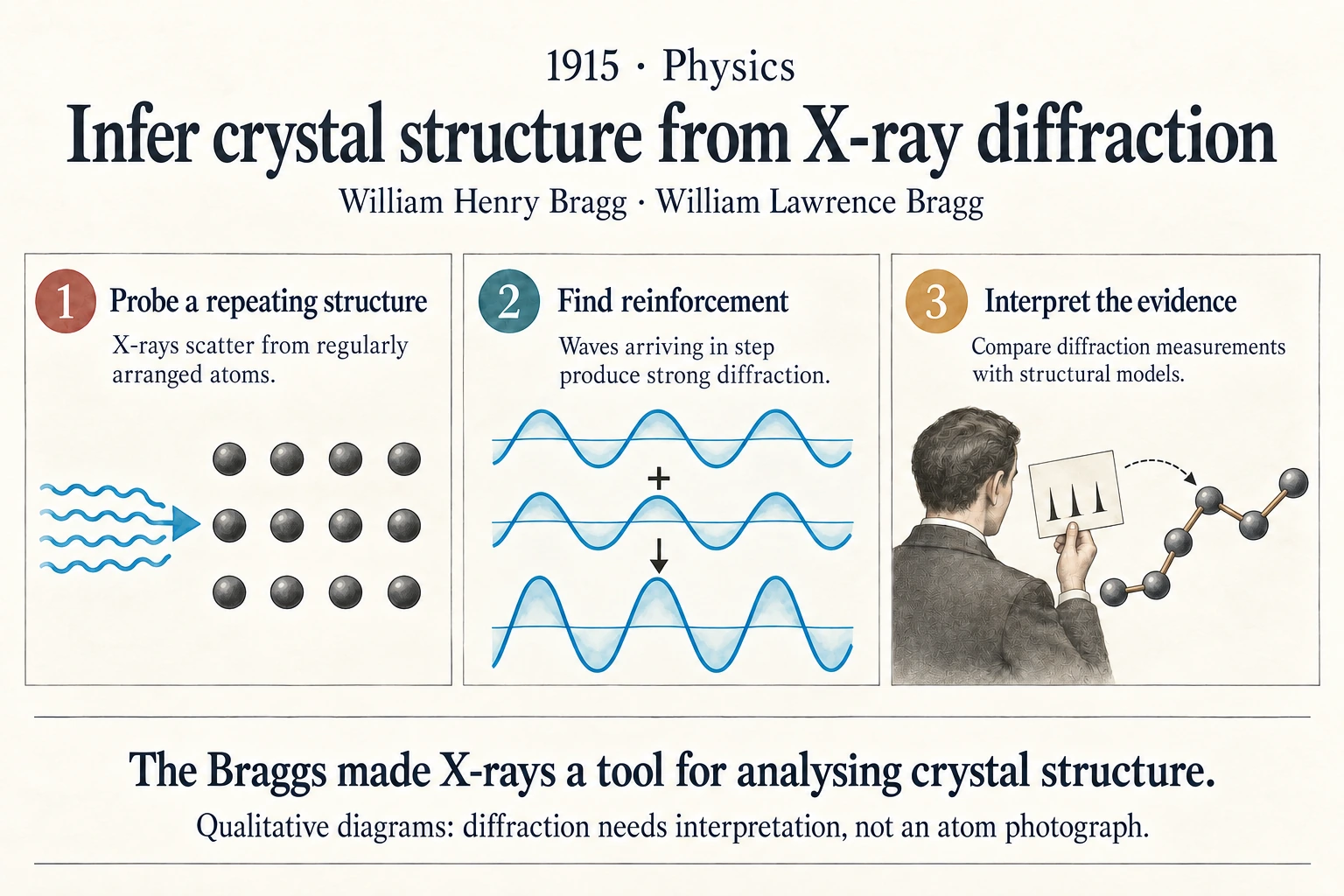
Infographic explaining Infer crystal structure from X-ray diffraction
Original AI-generated infographic. A conceptual overview; the explanations and sources below provide context.
Read the poster text

The Braggs made X-rays a tool for analysing crystal structure.

  1. Probe a repeating structure

    X-rays scatter from regularly arranged atoms.

  2. Find reinforcement

    Waves arriving in step produce strong diffraction.

  3. Interpret the evidence

    Compare diffraction measurements with structural models.

Qualitative diagrams: diffraction needs interpretation, not an atom photograph.

01 · The discovery

The idea, in everyday language

A crystal scatters X-rays from a repeating arrangement of atoms. Contributions from different parts can reinforce or cancel. Lawrence Bragg described the strong directions using families of parallel crystal planes: 2d sin θ = nλ. Here d is the spacing between planes, λ the wavelength, n an integer and θ the angle measured from the planes, not from their normal. This geometrical reflection picture expresses an interference condition; the planes are not ordinary tiny mirrors.

William Henry developed an X-ray spectrometer and made measurements that could be interpreted alongside this condition. Together, father and son investigated crystal arrangements and showed that diffraction could become a structural tool. Their prize concerned analysis of crystal structure. Laue’s earlier discovery of crystal diffraction and Barkla’s separate work on characteristic X-radiation are related parts of X-ray history, with different contributions.

Why it matters

X-ray crystallography opened a route from measurable diffraction to the arrangement of atoms. It became important across chemistry, mineralogy, materials and later biological structure research. A diffraction pattern still needs interpretation: it is evidence for a structure, rather than a direct photograph of atoms.
02 · The people

Who brought the idea to life?

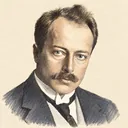
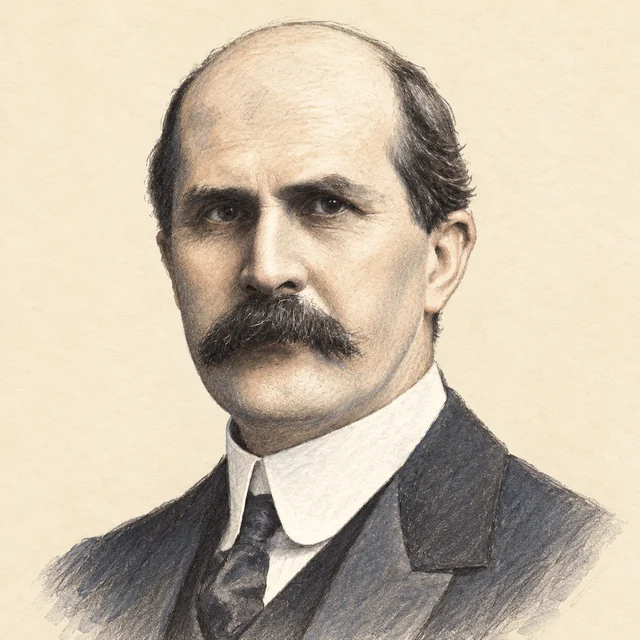
Illustrated portrait of William Henry Bragg

William Henry Bragg

Prize share · 1/2

William Henry Bragg received half the Physics Prize for developing X-ray analysis of crystal structure with his son. His spectrometer, experimental measurements and interpretation of X-ray behaviour made systematic structural investigation possible.

Read the biography ↗
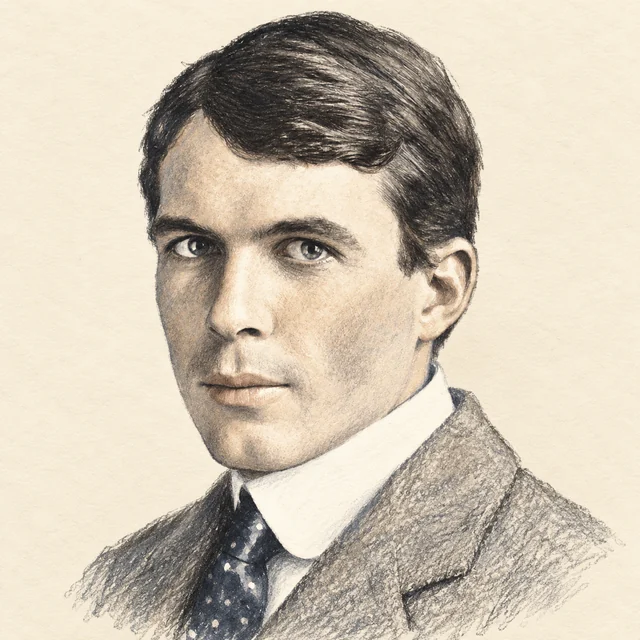
Illustrated portrait of William Lawrence Bragg

William Lawrence Bragg

Prize share · 1/2

William Lawrence Bragg received half the Physics Prize for the geometrical interpretation and structural use of X-ray diffraction. His reflection condition connected wavelength, crystal-plane spacing and angle, complementing his father’s instruments and measurements.

Read the biography ↗

03 · Years in the making

The path here

  1. 1912

    Lawrence presents a geometrical interpretation of crystal diffraction.

  2. 1913

    His paper is published; the Braggs develop structural X-ray analysis.

  3. 1915

    X-rays and Crystal Structure appears; father and son share the Physics Prize equally.

04 · Read further

From the original sources

Original explanations by Curionode, based on the official records below. Biographical details and affiliations refer to the award year.

  1. Official award summary nobelprize.org
  2. Historical presentation account nobelprize.org
  3. IUCr: Bragg’s law and its historical development dictionary.iucr.org