01 · The discovery
The idea, in everyday language
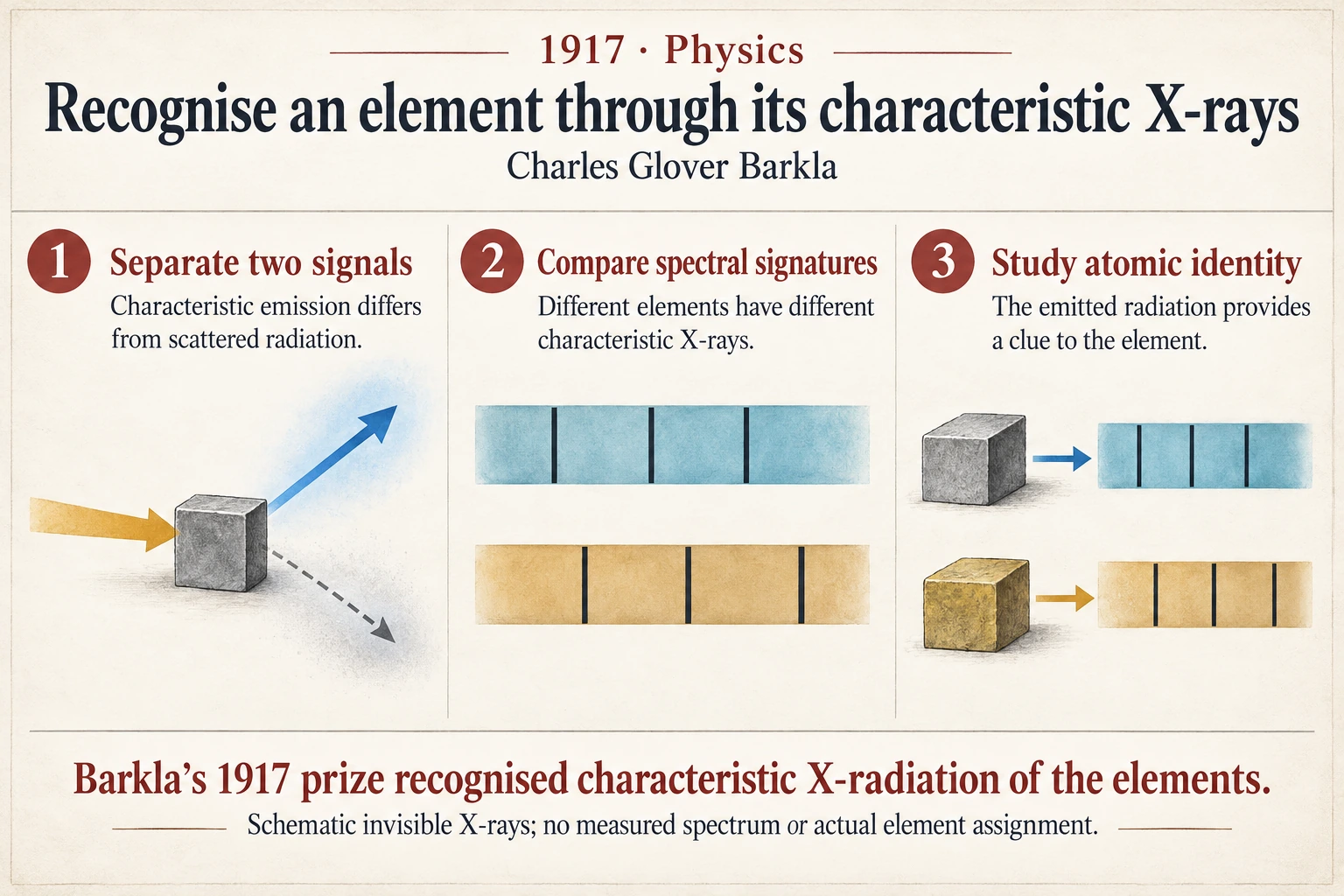
Shining X-rays onto matter produces more than a redirected incoming beam. Barkla separated scattered radiation from another component whose properties depended on the element being irradiated. Different chemical elements could be recognised through this characteristic radiation. In his investigations, absorption and penetrating power were important tools; the discovery was not simply a photograph of an atom.
He identified different families of characteristic radiation, known as the K and L series. The finding gave researchers a new connection between an element and its internal atomic structure. In modern language, characteristic X-ray emission can follow ionisation of an inner electron shell and the atom’s subsequent relaxation. That explanation developed beyond the original measurements. The 1917 prize was reserved and announced for Barkla on 12 November 1918; he attended the Nobel banquet in June 1920.
Why it matters
Characteristic X-ray spectra became tools for investigating atoms and identifying elements. Later wavelength measurements and atomic theory developed the implications further. Barkla’s contribution should be distinguished from Röntgen’s discovery of X-rays, crystal diffraction and later explanations of atomic spectra.