A life in context
The person behind the prize
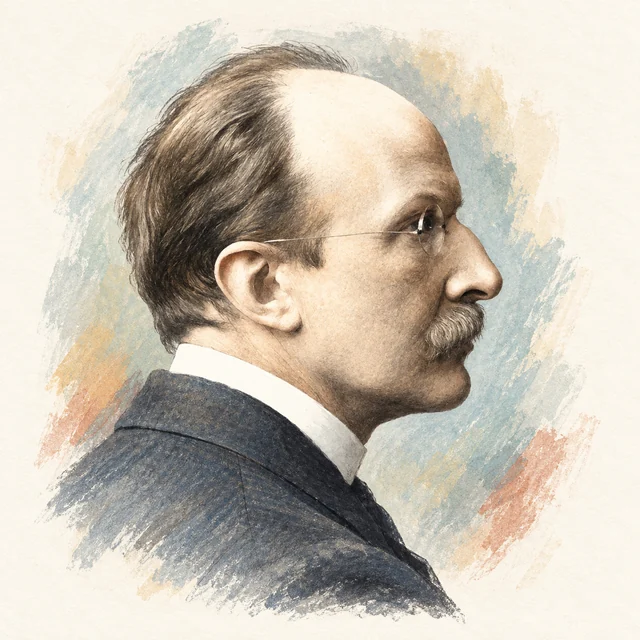
Planck was born in Kiel and grew up partly in Munich. He studied in Munich and Berlin, completing a doctorate on thermodynamics at Munich in 1879. After teaching in Munich and Kiel, he moved to Berlin in 1889. Heat, entropy and the search for general physical laws shaped his early work. From 1897 he studied the radiation of a body in thermal equilibrium. Measurements in 1900 showed that an existing radiation law could not describe the whole spectrum. He found a new law and, in deriving it, introduced finite energy elements whose size was proportional to frequency. The proportionality constant is now called Planck’s constant. This step helped open quantum theory, but it should not be collapsed into Einstein’s later light-quanta proposal or the complete quantum mechanics developed by others. The 1918 Physics Prize was reserved, announced on 13 November 1919 and presented on 1 June 1920. Berlin University was his award affiliation. He retired from his university chair in 1926 and led the Kaiser Wilhelm Society from 1930 to 1937. Its institutional history describes both his compromises under National Socialism and efforts to protect threatened colleagues. His son Erwin was executed in January 1945 after involvement in the plot against Hitler. Planck died in Göttingen in 1947. Scientific recognition and later institutional responsibility are distinct parts of his history.
The contribution
Planck received the full Physics Prize for discovering energy quanta. His work on black-body radiation introduced finite energy elements, with their size related to frequency through the constant now named after him.
The idea in plain language
A body in thermal equilibrium emits radiation across a spectrum. An ideal black body absorbs all radiation that falls on it; its equilibrium spectrum depends on temperature rather than the material. Researchers needed a law that agreed with measurements across the full range, not only one part of it. New measurements in 1900 showed that Wien’s law did not provide that complete description.
Read the full award story ↗

