A life in context
The person behind the prize
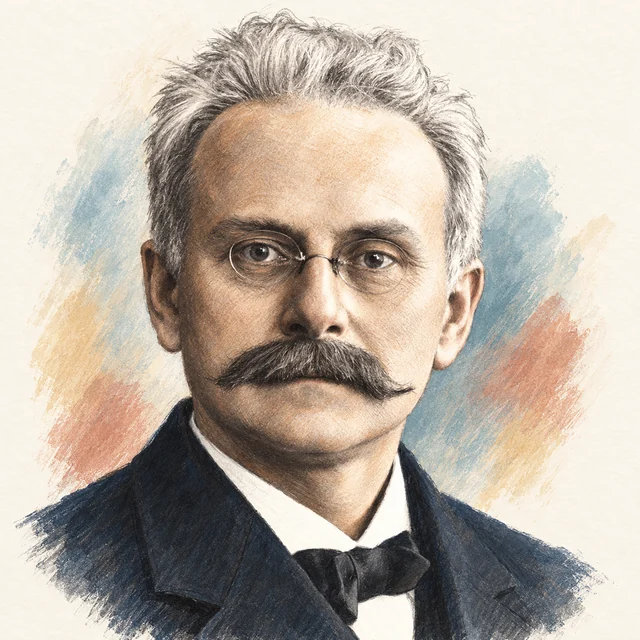
Stark was born in Schickenhof in Bavaria and studied in Munich, where he completed his doctorate in 1897. Later university posts took him to Göttingen, Hanover, Aachen and Greifswald. Light emitted by moving charged atoms offered a way to investigate both their motion and their internal behaviour. In 1905 he observed a Doppler effect in canal rays: the observed frequency depended on the direction of observation relative to the moving ions. He later investigated how electric fields affect emitted light. The 1919 presentation account dates his discovery of electric-field splitting of spectral lines to 1913. These two effects, rather than a single generic change of colour, were the contributions recognised by the full Physics Prize. Greifswald University was his award affiliation. The prize was presented on 1 June 1920; it had not been reserved for award in a later year. His subsequent history requires a separate judgement. Stark supported Nazism and promoted an antisemitic movement known as German Physics, attacking Einstein and modern theoretical physics. He headed the Physikalisch-Technische Reichsanstalt from 1933 to 1939 and the German Research Foundation from 1934 to 1936. The DFG’s institutional history documents his racist politics and authoritarian control of research funding. Those actions are not validated by the scientific award. He died in Traunstein in 1957.
The contribution
Stark received the full Physics Prize for discovering the Doppler effect in canal rays and the splitting of spectral lines in electric fields. The first relates observed light to the motion of emitting ions; the second probes the response of atomic light emission to an electric field.
The idea in plain language
A spectrum separates light into components, letting researchers compare the narrow lines emitted by atoms. Canal rays contain fast-moving positive ions. Stark showed in 1905 that their light exhibits a Doppler effect: looking along different directions relative to the motion changes the observed frequency. The motion of the emitter and the light received by an observer are connected.
Read the full award story ↗

