A life in context
The person behind the prize
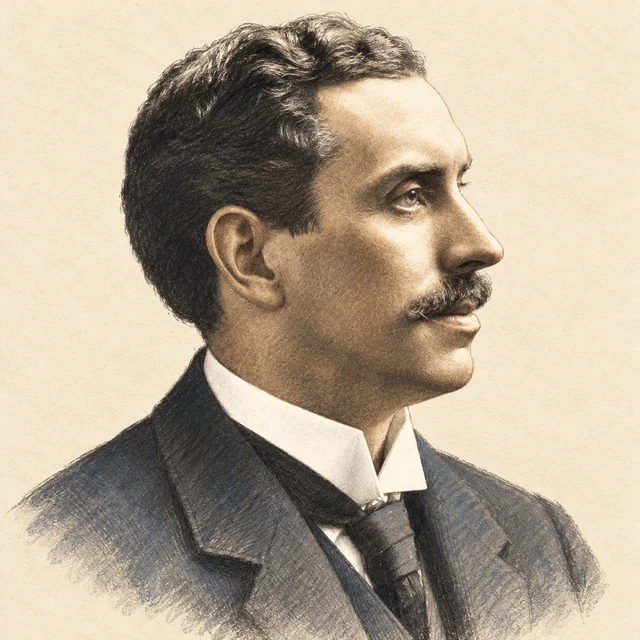
Barkla grew up in Widnes and studied mathematics and physics at University College, Liverpool, entering in 1894. He completed a physics degree in 1898 and a master’s degree the following year. A research scholarship took him to Cambridge, where he worked with J. J. Thomson at the Cavendish Laboratory. He also joined King’s College and sang in its chapel choir. Returning to Liverpool in 1902, he developed the X-ray investigations that shaped his scientific career. He distinguished radiation scattered from an incoming beam from a different kind emitted by the irradiated material itself. That characteristic radiation revealed a connection between an element and the X-rays it could emit. His research also included the polarisation and absorption of X-rays. After a London professorship from 1909, he moved to Edinburgh in 1913 as professor of natural philosophy, remaining there until his death in 1944. Edinburgh University was his affiliation for the prize. The 1917 Physics Prize was reserved and its award to Barkla was announced on 12 November 1918. His Nobel banquet took place on 1 June 1920, followed by his lecture on 3 June. These dates describe different stages of the award rather than three different prizes. His work helped make X-ray spectra a way of studying the internal properties of atoms.
The contribution
Barkla received the full Physics Prize for discovering the characteristic X-radiation of the elements. He distinguished this element-dependent emission from scattered incident radiation and investigated its absorption and families of penetrating power.
The idea in plain language
Shining X-rays onto matter produces more than a redirected incoming beam. Barkla separated scattered radiation from another component whose properties depended on the element being irradiated. Different chemical elements could be recognised through this characteristic radiation. In his investigations, absorption and penetrating power were important tools; the discovery was not simply a photograph of an atom.
Read the full award story ↗

