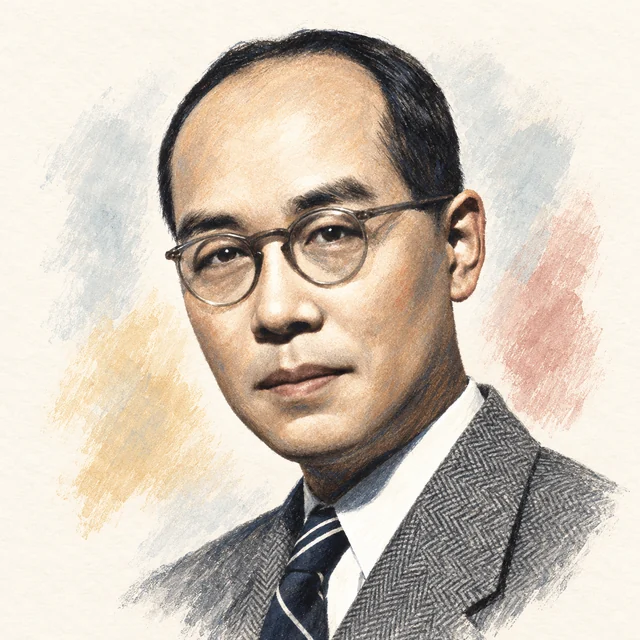
A life in context
The person behind the prize
Yukawa graduated from Kyoto Imperial University in 1929 and taught at Kyoto and Osaka during the following decade. The problem of how protons and neutrons bind in a nucleus led him to a new theoretical proposal in 1934, published in 1935: a particle with an intermediate mass could mediate a force with a short range. He received his doctorate in 1938 and became a Kyoto professor in 1939. Cosmic-ray discoveries required careful interpretation: the particle identified in cosmic rays in the 1930s, now called the muon, was not the strongly interacting particle his theory needed. The discovery of the pion in 1947 gave the proposal a different experimental footing. After a visiting appointment at the Institute for Advanced Study in 1948, he became a visiting professor at Columbia in July 1949. Both Columbia and Kyoto are recorded affiliations for his full 1949 Physics Prize. The award recognised a theoretical prediction, rather than the experimental discovery of all particles historically called mesons.
The contribution
Yukawa connected the short range of nuclear forces with the mass of an exchanged particle and predicted mesons. He received the full Physics Prize; experimental identification was the work of other researchers.
The idea in plain language
Why do protons and neutrons bind together inside a nucleus, while this powerful attraction has such a limited reach? Yukawa proposed that an interaction carried by a particle with mass would have a characteristic short range. The observed scale of nuclei therefore suggested a previously unknown particle, heavier than the electron but lighter than a proton. He developed the idea in 1934 and published it in 1935.
Read the full award story ↗

