01 · The discovery
The idea, in everyday language
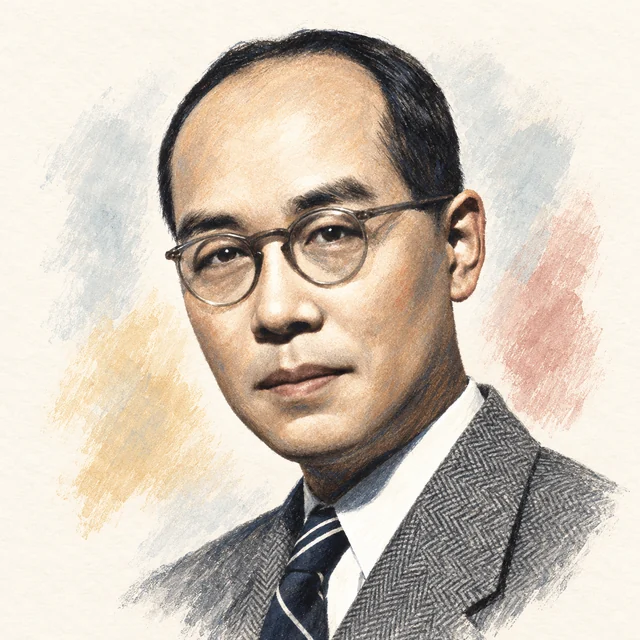
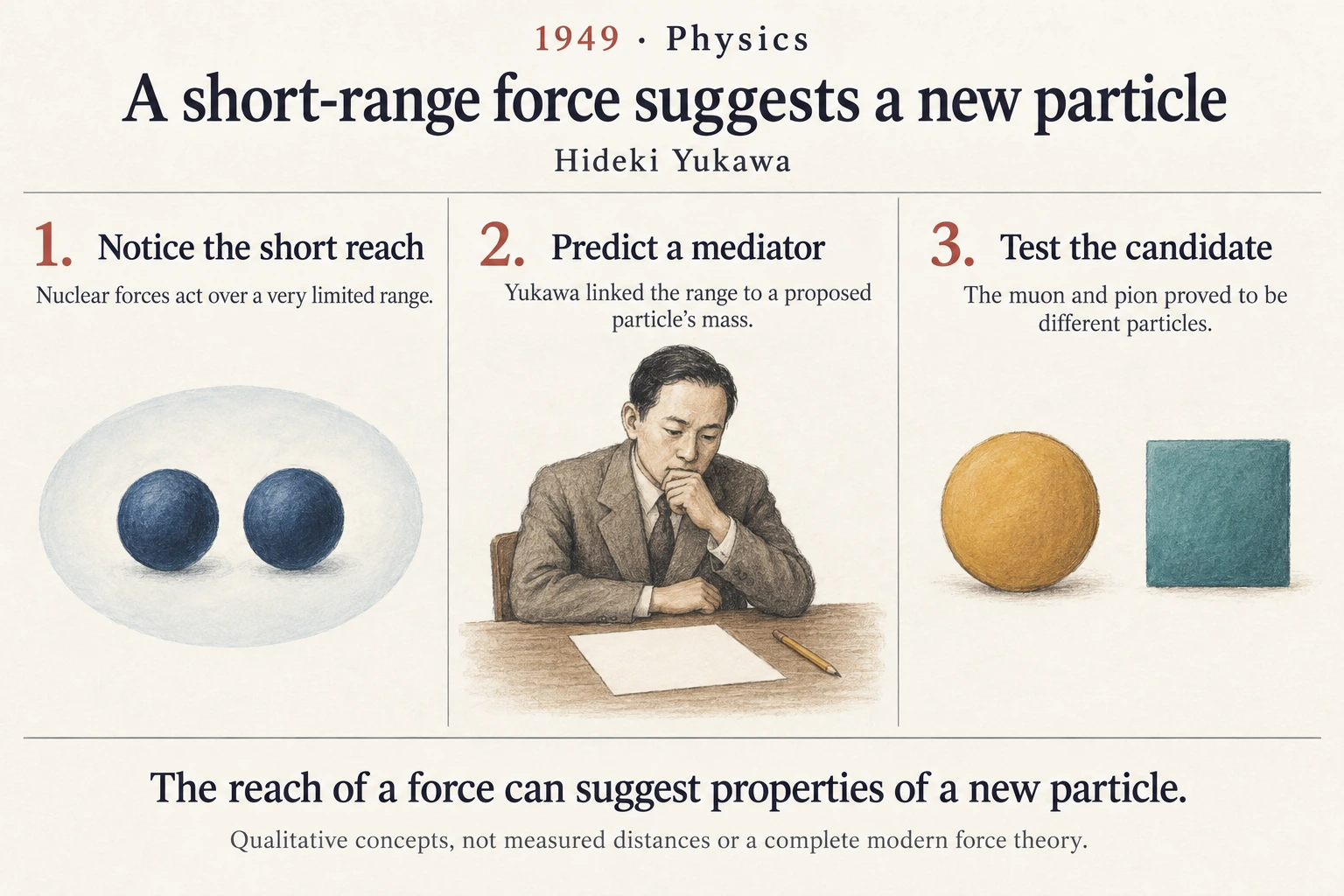
Why do protons and neutrons bind together inside a nucleus, while this powerful attraction has such a limited reach? Yukawa proposed that an interaction carried by a particle with mass would have a characteristic short range. The observed scale of nuclei therefore suggested a previously unknown particle, heavier than the electron but lighter than a proton. He developed the idea in 1934 and published it in 1935.
Finding a particle of roughly suitable mass was not enough. The cosmic-ray particle identified in the 1930s, now called the muon, did not show the strong nuclear interactions required by the proposal. The pion identified in 1947 provided different evidence. The 1949 prize recognised Yukawa’s theoretical prediction; the experimental discoveries involved other researchers, including the Bristol team whose photographic methods were recognised in 1950.
Why it matters
The theory made the range of a force a clue to the properties of a particle. Meson-exchange ideas became important in describing residual nuclear forces between protons and neutrons, and prediction could be tested against the behaviour of newly observed particles.