01 · The discovery
The idea, in everyday language
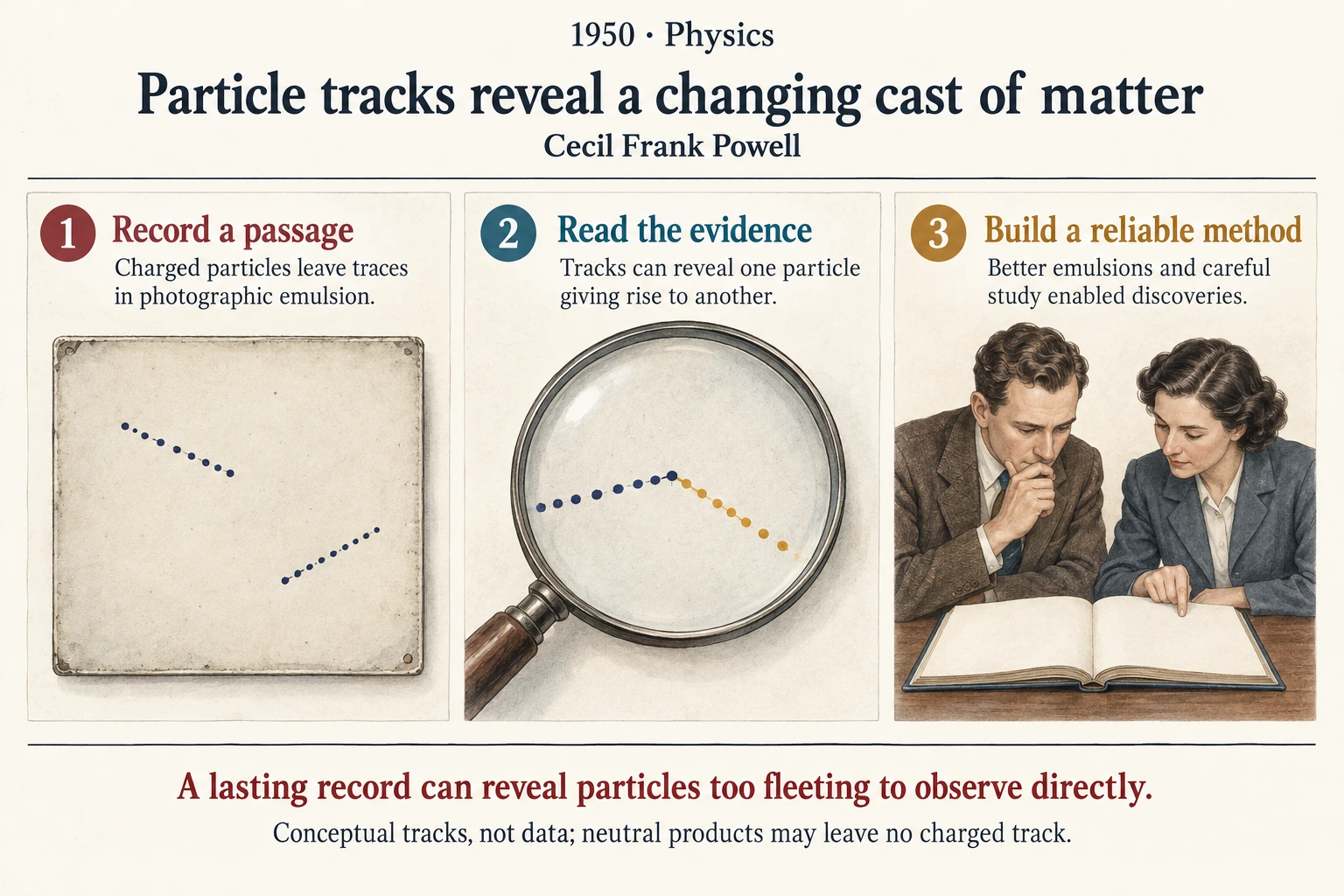
How can an extremely small, short-lived particle be studied after it has passed? A charged particle can leave an ionisation trail in a photographic emulsion. Development reveals affected grains, and a microscope makes the track available for close examination. Powell improved the sensitivity and reliability of this older principle with colleagues and emulsion manufacturers.
In 1947 Lattes, Muirhead, Occhialini and Powell reported tracks indicating that one kind of particle could give rise to another. The distinction between pions and the particles now called muons helped resolve a puzzle in cosmic-ray research. The method combined recording, careful scanning and interpretation; identifying a particle required several kinds of evidence, not simply recognising a line in a picture.
Why it matters
The technique provided a compact, lasting record of rare events and expanded particle physics. Powell alone received the 1950 prize, while the papers and investigations involved a wider team, including the women who searched emulsions under microscopes. Photographic emulsions and cloud chambers were different recording methods.