A life in context
The person behind the prize
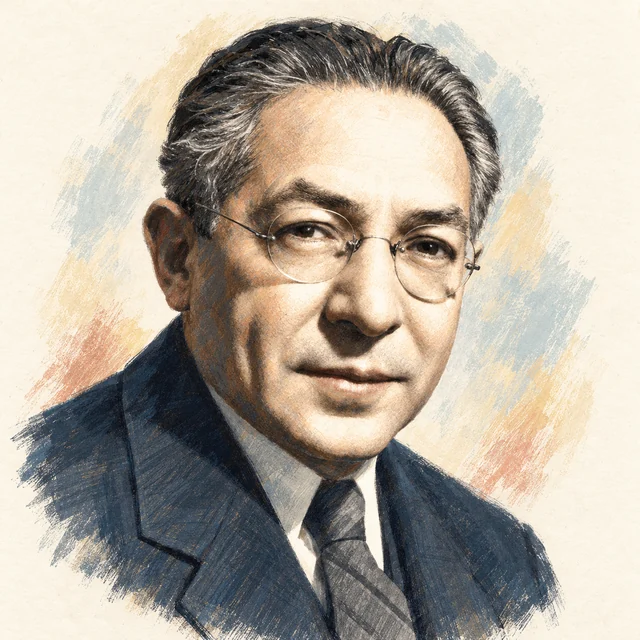
Rabi grew up in New York after his family emigrated from Europe. He studied chemistry at Cornell, graduating in 1919, and completed a doctorate on crystal magnetism at Columbia in 1927. Work in European physics laboratories, including Otto Stern’s molecular-beam group, helped shape his approach to measuring magnetic properties. He joined Columbia as a lecturer in 1929 and became a professor in 1937. In 1938 he and his collaborators reported a resonance method for measuring nuclear magnetic moments. Changing a nucleus’s magnetic state changed how a molecular beam was refocused, making resonance visible as a decrease in the beam reaching a detector. The original report named Rabi, Jerrold Zacharias, Sidney Millman and Polykarp Kusch; the full 1944 Physics Prize went to Rabi. During the war he was an associate director at MIT’s Radiation Laboratory, working on radar. His return to Columbia in 1945 and subsequent involvement in Brookhaven belong to his later career. His beam method should be distinguished from the bulk-material magnetic resonance work honoured in 1952.
The contribution
Rabi developed a molecular-beam resonance method for recording the magnetic properties of atomic nuclei. He received the whole Physics Prize.
The idea in plain language
How could physicists measure the magnetic properties of an atomic nucleus with precision? A molecular beam offered a way to connect an internal quantum property to something observable: how molecules were deflected and refocused by magnetic fields. Rabi developed a resonance method that made the connection much more precise.
Read the full award story ↗

