A life in context
The person behind the prize
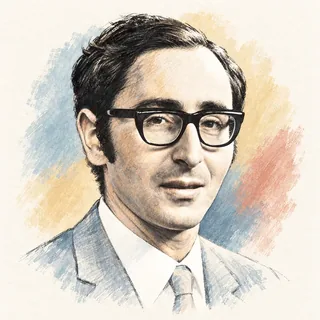
Giaever trained as a mechanical engineer at the Norwegian Institute of Technology, graduating in 1952. After military service and work as a patent examiner, he emigrated to Canada in 1954 and to the United States in 1956. General Electric’s engineering programme brought him into applied mathematics and industrial research. Joining its research centre in 1958, he also studied physics at Rensselaer, earning a doctorate in 1964. His 1960 experiments passed electrons through a thin oxide barrier and revealed the superconducting energy gap. Tunnelling became a way to investigate electronic states, not merely an unexpected current. Later he moved toward biophysics, including proteins at surfaces. The prize recognised his superconducting tunnelling experiments while he was at General Electric.
The contribution
Giaever used electron tunnelling through a thin insulating layer to investigate superconductors and their energy gap. He received one quarter of the Physics Prize.
The idea in plain language
Esaki studied heavily doped semiconductor junctions. Their narrow barrier allowed electrons to tunnel, producing the distinctive response of a tunnel diode. Giaever studied a different junction: a thin insulating layer next to superconducting material. Measuring its tunnelling current exposed the energy gap associated with superconductivity. The current became a probe of electronic states.
Read the full award story ↗