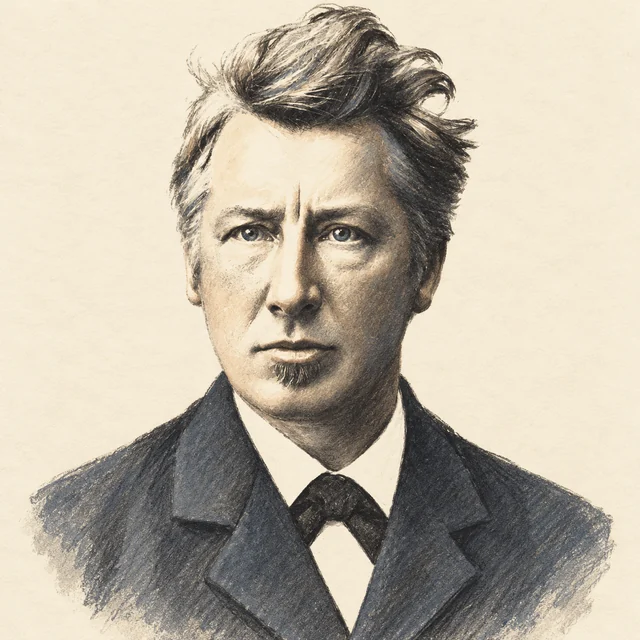
A life in context
The person behind the prize
Jacobus Henricus van ’t Hoff was born in Rotterdam and began studying at the Polytechnic in Delft in 1869. After completing its course he studied in Leiden, with August Kekulé in Bonn and with Charles-Adolphe Wurtz in Paris, before receiving his doctorate at Utrecht in 1874. In that same year he proposed a three-dimensional account of carbon bonding that helped explain why compounds could share a composition yet differ in their optical behaviour. Joseph Achille Le Bel independently developed related ideas. This work helped found stereochemistry, but the first Chemistry Prize was specifically awarded for chemical dynamics and osmotic pressure in solutions. After teaching in Utrecht, van ’t Hoff joined Amsterdam in 1877 and became professor the following year. His 1884 book Études de dynamique chimique connected experimental changes in chemical systems with quantitative reasoning about reaction rates and equilibrium. Rates describe how quickly change proceeds; equilibrium describes the balance reached under specified conditions. They are related questions, rather than interchangeable measures. In the 1880s he also identified a striking relationship between dilute solutions and gases. Wilhelm Pfeffer had measured osmotic pressure with membranes that let water pass while retaining dissolved sugar. Van ’t Hoff connected that pressure with the number of dissolved particles, concentration and temperature, using the gas law as a model. Electrolytes required attention to the additional particles produced by dissociation, linking this subject with Arrhenius’s work. The comparison did not mean that a liquid solution literally becomes a gas or that all concentrated solutions obey an ideal law exactly. Nor does osmotic equilibrium require equal solute concentrations on both sides: an opposing pressure can balance the tendency of solvent to enter a solution. In 1887 he helped establish a journal of physical chemistry with Wilhelm Ostwald. A move to Berlin in 1896 gave him greater freedom for research through a position at the Prussian Academy and an honorary university professorship. With Wilhelm Meyerhoffer he investigated the conditions under which oceanic salt deposits form, applying physical chemistry to geological questions. He received the full 1901 Chemistry Prize and died at Steglitz in 1911. His career shows how models, measurements and thermodynamics could give apparently different chemical phenomena a common quantitative language.
The contribution
Van ’t Hoff developed quantitative approaches to chemical dynamics and the osmotic pressure of dilute solutions. His full Chemistry Prize recognised these contributions; tetrahedral carbon was another influential part of his work.
The idea in plain language
Chemical dynamics asks about changes in chemical systems, including rates and equilibrium. Van ’t Hoff helped connect those questions with quantitative models and thermodynamics rather than describing reactions only by their final products.
Read the full award story ↗

