A life in context
The person behind the prize
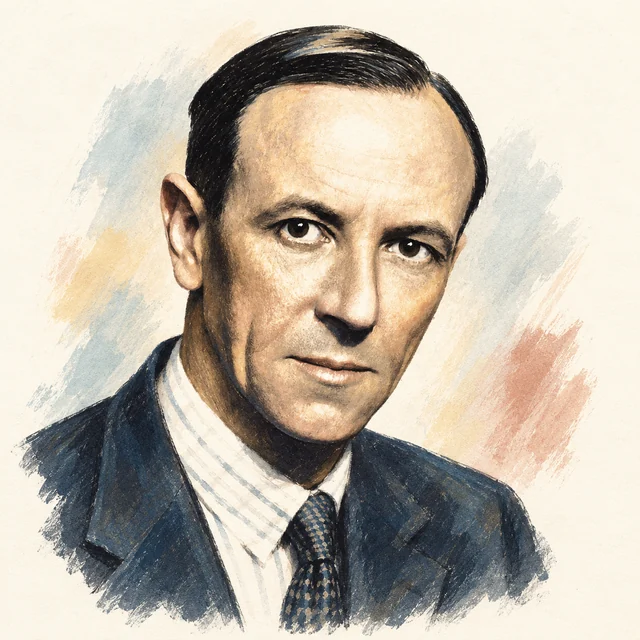
Chadwick grew up in Cheshire and Manchester, entering Manchester University in 1908 and graduating in physics in 1911. After research with Ernest Rutherford, he went to Berlin to work with Hans Geiger in 1913. The First World War interrupted this work: he was interned at Ruhleben. Returning to research with Rutherford at Cambridge, he received his doctorate in 1921 and became assistant director of research at the Cavendish Laboratory in 1923. His 1932 investigation of penetrating radiation from beryllium supplied evidence for a neutral particle with a mass close to the proton’s. It built on observations by Bothe and Becker and by Irène and Frédéric Joliot-Curie. Chadwick moved to Liverpool in 1935, the year he received the full Physics Prize. Liverpool was his award affiliation; the neutron work had been done at Cambridge. His later leadership of the British mission to the Manhattan Project belonged to the wartime phase of his career. He was knighted in 1945.
The contribution
Chadwick received the full Physics Prize for discovering the neutron. Comparing the energy transferred to recoiling nuclei supported a neutral particle of approximately proton mass rather than the proposed gamma-ray explanation.
The idea in plain language
By 1930 Bothe and Becker had observed penetrating radiation when alpha particles struck beryllium. Irène and Frédéric Joliot-Curie then found that this radiation could eject fast protons from hydrogen-containing material. They interpreted it as very energetic gamma radiation. Chadwick tested the energy transferred in collisions with different nuclei. The gamma-ray interpretation required implausible energies and failed to account consistently for the observations.
Read the full award story ↗

