A life in context
The person behind the prize
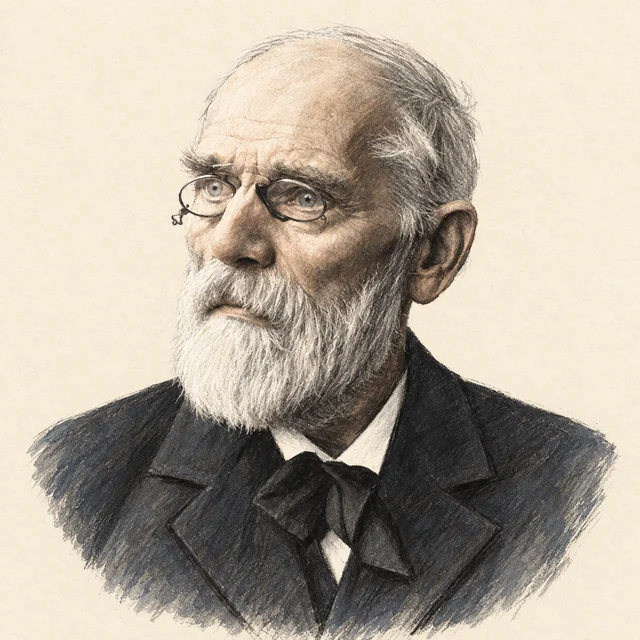
Johannes Diderik van der Waals began as a schoolteacher in Leiden. Lacking the classical-language education required for university examinations, he nevertheless attended scientific lectures while working. Changes in the rules eventually allowed him to take the examinations, and in 1873 he earned a doctorate for a thesis on the continuity of the gas and liquid states. To explain deviations from simple gas laws, he considered both the space molecules occupy and their mutual attraction. In 1877 he became the first professor of physics at the newly constituted University of Amsterdam; the higher-education law enabling its transformation had been passed in 1876. He developed the principle of corresponding states in 1880, comparing substances through properties scaled by their critical values. Research on mixtures and capillarity extended the programme. His ideas helped guide low-temperature investigations, including Heike Kamerlingh Onnes’s production of liquid helium in 1908, but the experimental achievements belonged to the laboratories and teams that carried them out. Van der Waals retired in 1908, before receiving the full 1910 Physics Prize. His son, also named Johannes Diderik, was one of his academic successors and is a different person. He died in Amsterdam in 1923. His equation remains a powerful simplified model, rather than an exact description of every fluid.
The contribution
Van der Waals received the full Physics Prize for work on the equation of state of gases and liquids. Molecular size and attraction helped connect their behaviour within one framework, including the existence of a critical point.
The idea in plain language
An ideal gas model treats particles as having negligible volume and no mutual attraction. This can work well for dilute gases, but becomes inadequate as molecules crowd together or attractions matter more. Van der Waals modified the relation between pressure, volume and temperature to account approximately for both effects. The same substance could then be understood in gaseous and liquid states without inventing a different kind of molecule for each.
Read the full award story ↗

