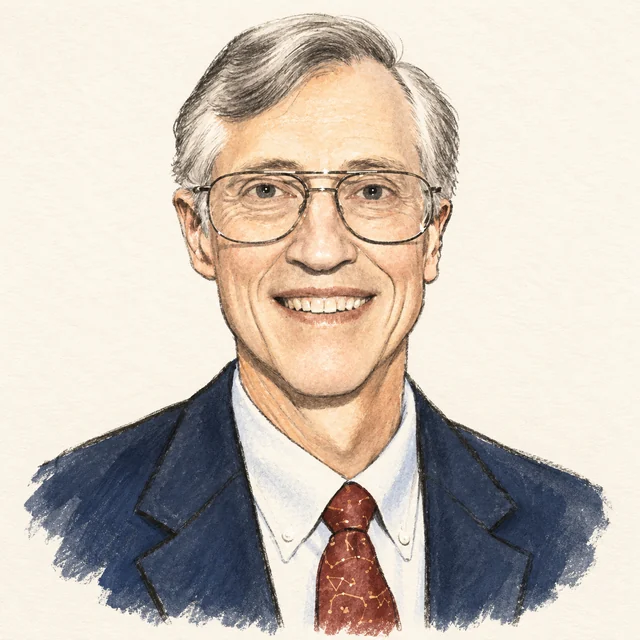
A life in context
The person behind the prize
Mather trained as a physicist and received his doctorate at the University of California, Berkeley in 1974. At NASA Goddard he helped develop the Cosmic Background Explorer, or COBE: a satellite designed to measure faint radiation across the sky. The work required scientists and engineers to distinguish a signal from the early universe from emissions by the instrument, Earth and our own galaxy.
The contribution
Mather coordinated the COBE science effort and led the experiment measuring how the microwave background’s intensity changes with frequency. Its FIRAS instrument found an extraordinarily close match to the thermal spectrum called a blackbody. This supplied a stringent test of the picture of an initially hot universe that expanded and cooled. The result belonged to a large collaboration, not to a lone observer.
The idea in plain language
The sky contains a faint microwave glow left from an early hot stage of the universe. As space expanded, that radiation stretched and cooled. COBE measured it from above the atmosphere. Mather’s experiment found the precise pattern of intensity across frequencies expected from thermal radiation, a blackbody spectrum at about 2.7 kelvin today.
Read the full award story ↗