A life in context
The person behind the prize
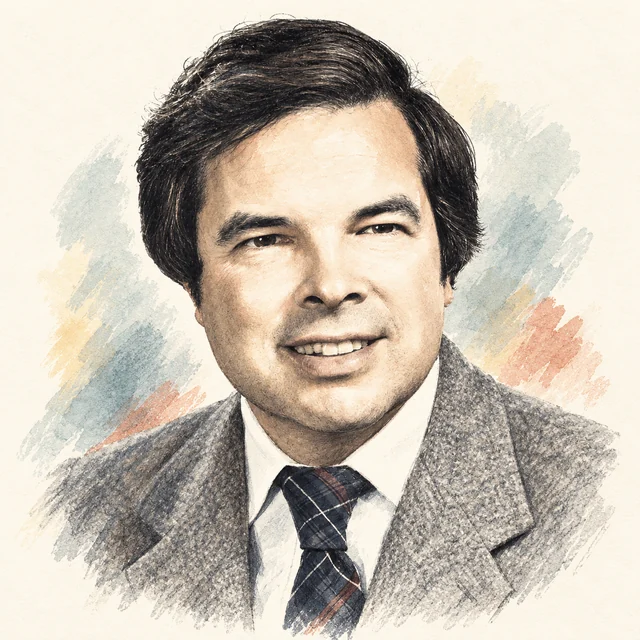
Wilson grew up in a family with strong scientific interests and entered Harvard in 1952, studying mathematics alongside physics. At Caltech he combined theoretical training with laboratory and computing experience, earning his doctorate under Murray Gell-Mann in 1961. After a Harvard Junior Fellowship and a period at CERN, he joined Cornell in September 1963. Conversations with Michael Fisher and Benjamin Widom helped connect his particle-physics questions with statistical mechanics. His 1971 work made the renormalization group a practical framework for critical phenomena. He also developed lattice gauge theory and promoted scientific computing. He later moved to Ohio State and worked on science education; those activities extend beyond the research recognised in 1982.
The contribution
Wilson explained how fluctuations on many length scales determine behaviour near a critical point. Successive averaging changes an effective model and reveals scaling laws and universality classes. He received the full Physics Prize. Earlier scaling ideas and the work of Fisher, Widom, Kadanoff and others were essential foundations; the result was not a claim that every phase transition behaves identically.
The idea in plain language
A magnet near its Curie point can have correlated regions of many sizes. A liquid near its liquid–gas critical point also develops large density fluctuations. Simply replacing each particle’s surroundings with an average field misses important correlations: the small and large scales influence one another.
Read the full award story ↗

