c.curionodeThe Nobel Archive

1982 · Physics

When every scale matters

Near a critical point, microscopic fluctuations can reach across a material. Wilson made their many scales part of a calculable theory.

Critical phenomenaRenormalization groupUniversality
1982Physics

Visual guide

The prize, pictured

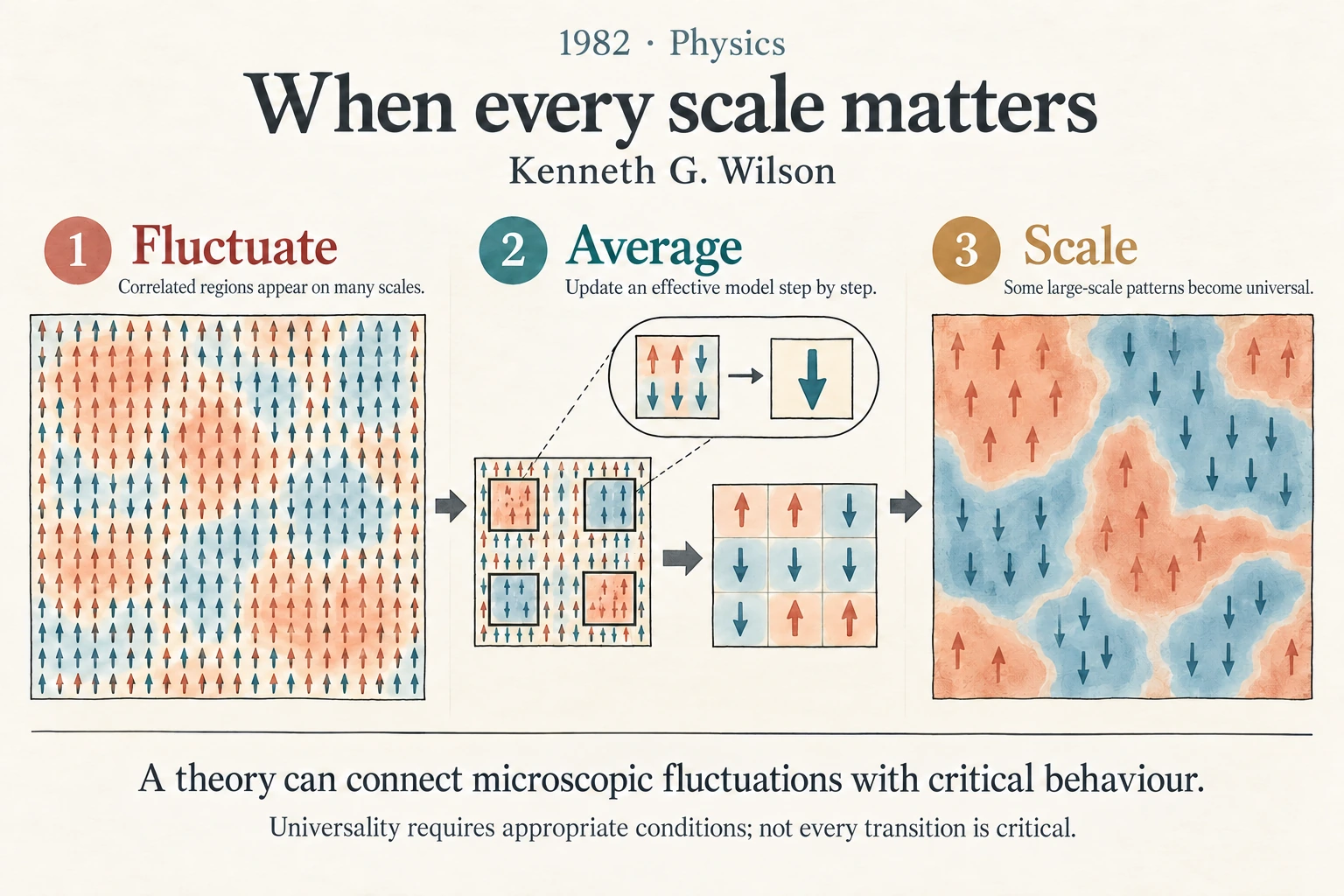
Infographic explaining When every scale matters
Original AI-generated infographic. A conceptual overview; the explanations and sources below provide context.
Read the poster text

A theory can connect microscopic fluctuations with critical behaviour.

  1. Fluctuate

    Correlated regions appear on many scales.

  2. Average

    Update an effective model step by step.

  3. Scale

    Some large-scale patterns become universal.

Universality requires appropriate conditions; not every transition is critical.

01 · The discovery

The idea, in everyday language

A magnet near its Curie point can have correlated regions of many sizes. A liquid near its liquid–gas critical point also develops large density fluctuations. Simply replacing each particle’s surroundings with an average field misses important correlations: the small and large scales influence one another.

The renormalization group handles those scales in successive steps. Short-distance fluctuations are averaged out, distances rescaled, and the effective interactions updated. Repeating the operation reveals which features grow, which fade and which scaling laws remain. Different microscopic systems can approach the same kind of large-scale behaviour, forming a universality class under appropriate conditions.

Why it matters

Wilson’s framework explained why some critical exponents agree across quite different materials and enabled quantitative calculations beyond simple mean-field theory. It connected statistical mechanics with methods from quantum field theory and encouraged numerical work. The result built on Landau’s theory, Onsager’s exact example and scaling ideas developed by Fisher, Widom, Kadanoff and others.

02 · The people

Who brought the idea to life?

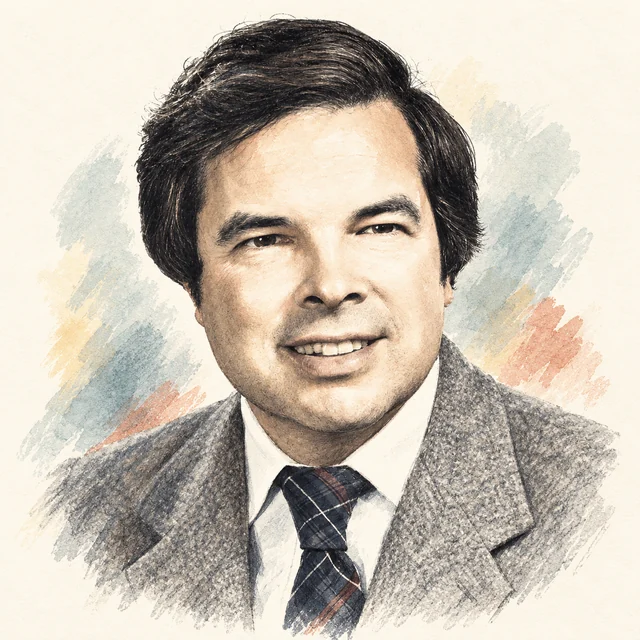
Illustrated portrait of Kenneth G. Wilson

Kenneth G. Wilson

Prize share · 1/1

Wilson explained how fluctuations on many length scales determine behaviour near a critical point. Successive averaging changes an effective model and reveals scaling laws and universality classes. He received the full Physics Prize. Earlier scaling ideas and the work of Fisher, Widom, Kadanoff and others were essential foundations; the result was not a claim that every phase transition behaves identically.

Read the biography ↗

03 · Years in the making

The path here

  1. 1961

    Wilson completes his Caltech doctorate.

  2. 1963

    He joins Cornell, where statistical mechanics and particle theory meet.

  3. 1971

    His renormalization-group papers transform the treatment of critical phenomena.

  4. 1982

    He receives the full Physics Prize for the theory.

04 · Read further

From the original sources

Original explanations by Curionode, based on the official records below. Biographical details and affiliations refer to the award year.

  1. Official announcement nobelprize.org
  2. Wilson’s lecture on critical phenomena nobelprize.org
  3. Cornell: Wilson’s scientific career news.cornell.edu