01 · The discovery
The idea, in everyday language
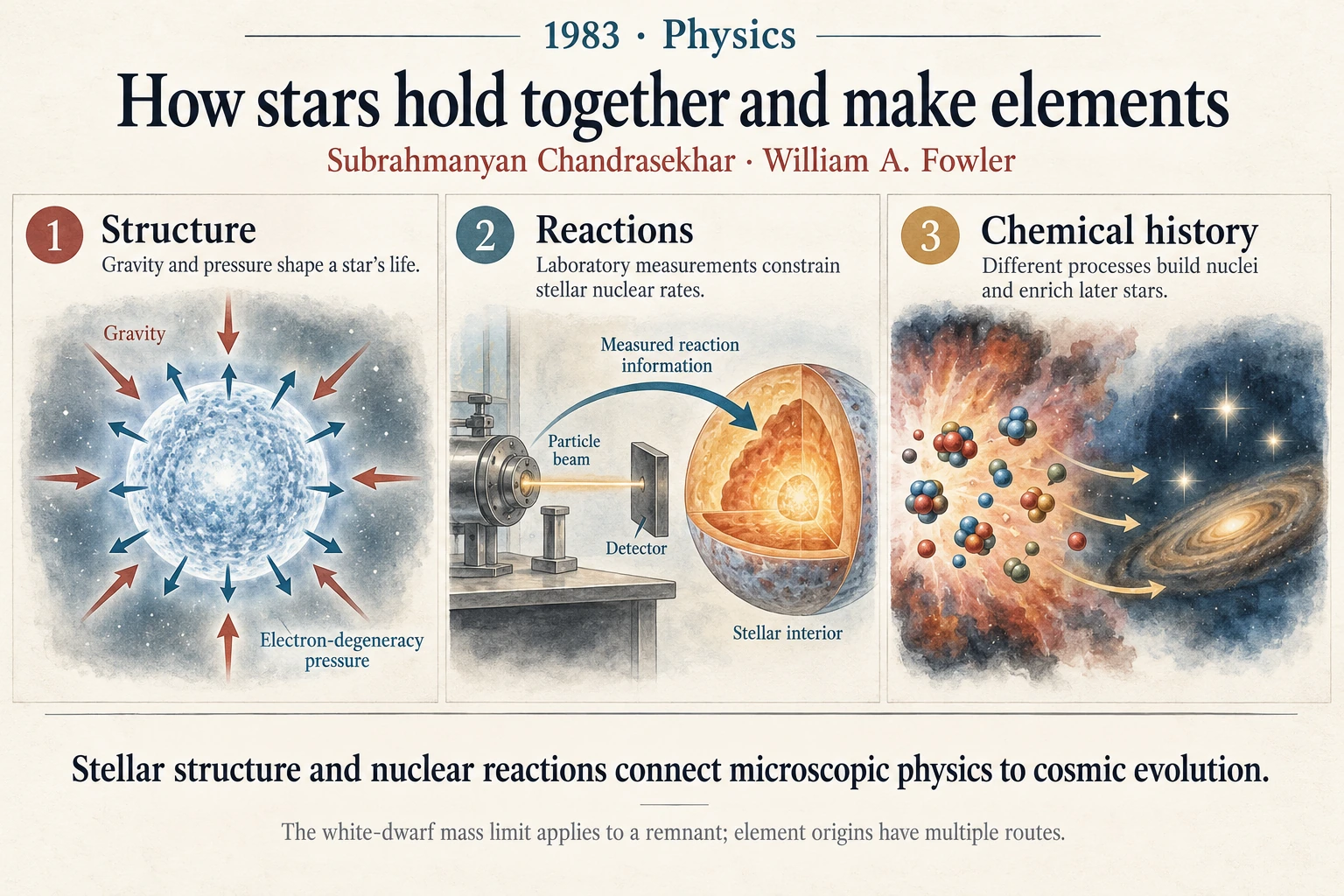
Gravity pulls stellar matter inward. Pressure can resist it, but the source of that pressure changes as a star evolves. Chandrasekhar studied these balances mathematically. In an idealised cold, nonrotating white dwarf, quantum electron degeneracy pressure has a limiting mass of roughly 1.4 Suns for common compositions. Including relativity is essential to this result.
Fowler’s experiments measured the probabilities of nuclear reactions; theory translates those measurements into rates at stellar temperatures. With the Burbidges, Hoyle and many laboratory colleagues, he developed a quantitative account of nucleosynthesis. Different burning and neutron-capture processes make different nuclei, and expelled matter can become material for later stars and planets.
Why it matters
These complementary programmes linked microscopic physics to stellar lives and cosmic chemical history. Reaction measurements constrain astrophysical calculations; structural theory explains which configurations can persist. Their reach includes stellar remnants, rather than a promise that one simple diagram predicts every star’s fate.