A life in context
The person behind the prize
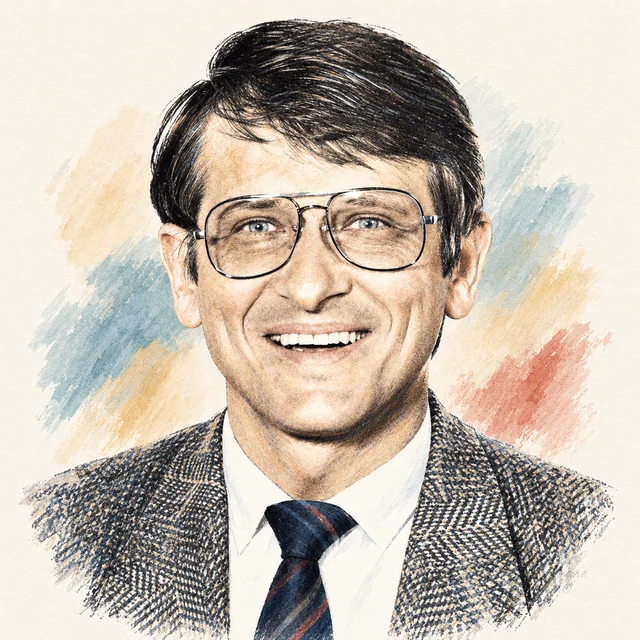
Von Klitzing studied physics at Braunschweig, receiving his diploma in 1969, and completed a doctorate at Würzburg in 1972. Research visits took him to Oxford and Grenoble, where very strong magnetic fields were available. In 1980 he discovered integer quantisation of Hall resistance in a two-dimensional electron gas in a silicon transistor. The paper was written with Gerhard Dorda and Michael Pepper, who contributed semiconductor expertise and samples. He became professor in Munich later in 1980 and director at the Max Planck Institute in Stuttgart in January 1985. The Stuttgart institute was his award affiliation.
The contribution
Von Klitzing discovered the integer quantum Hall effect: under suitable conditions, Hall resistance takes plateau values h/(νe²), with integer ν. Hall voltage is measured across the current direction; this resistance differs from longitudinal resistance along the current. The reproducible relation became a foundation for precise resistance standards. He received the full Physics Prize.
The idea in plain language
In the ordinary Hall effect, a magnetic field produces a voltage across a conductor carrying current. In a very thin electron system, low temperature and a strong perpendicular field reveal a different pattern: Hall resistance develops plateaux. Von Klitzing discovered this integer quantum Hall effect in 1980 using a silicon transistor at Grenoble.
Read the full award story ↗

