c.curionodeThe Nobel Archive

1985 · Physics

A quantum reference for electrical resistance

Von Klitzing found that Hall resistance can settle on reproducible values set by fundamental constants.

quantum Hall effectresistancetwo-dimensional electronsmeasurement
1985Physics

Visual guide

The prize, pictured

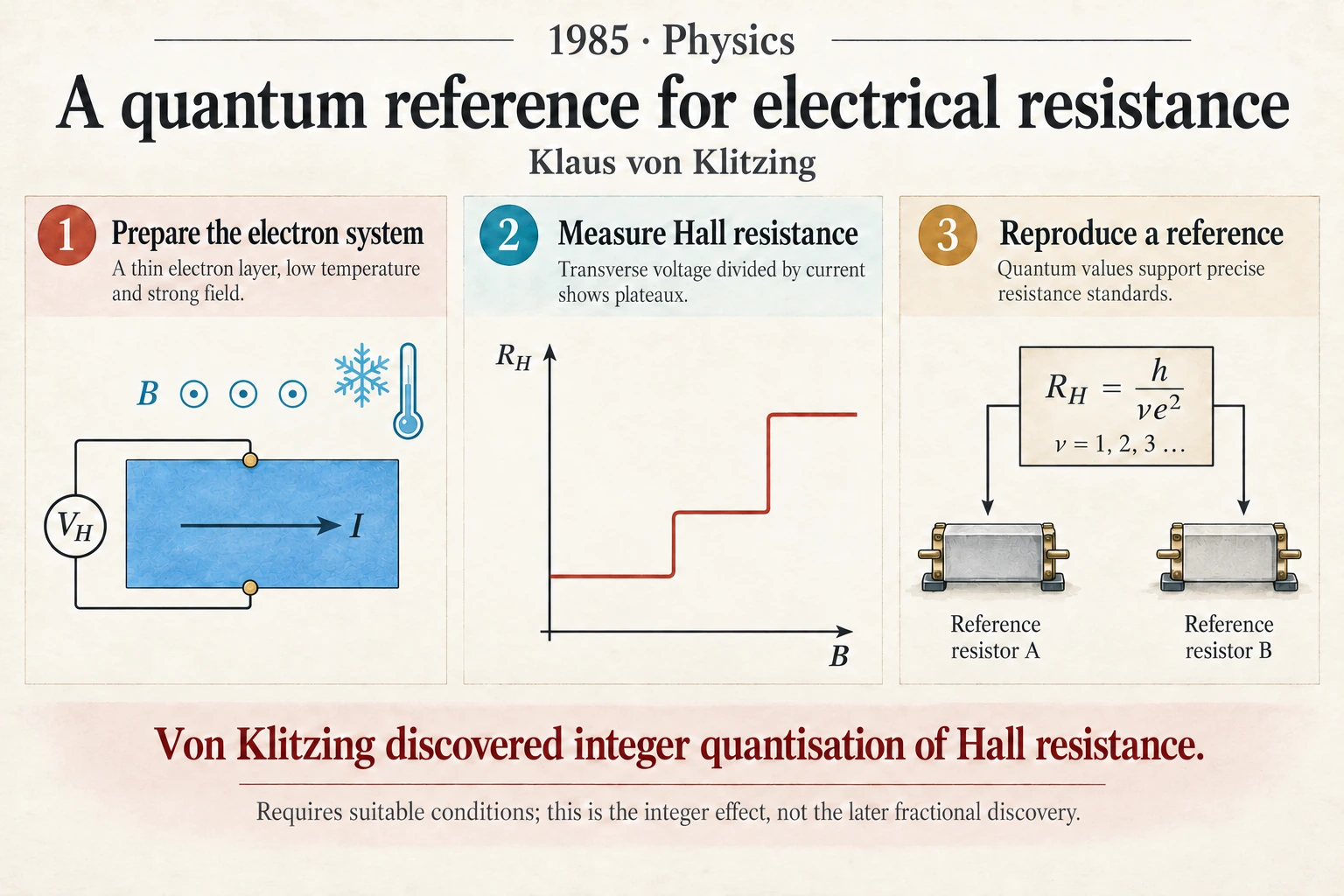
Infographic explaining A quantum reference for electrical resistance
Original AI-generated infographic. A conceptual overview; the explanations and sources below provide context.
Read the poster text

Von Klitzing discovered integer quantisation of Hall resistance.

  1. Prepare the electron system

    A thin electron layer, low temperature and strong field.

  2. Measure Hall resistance

    Transverse voltage divided by current shows plateaux.

  3. Reproduce a reference

    Quantum values support precise resistance standards.

Requires suitable conditions; this is the integer effect, not the later fractional discovery.

01 · The discovery

The idea, in everyday language

In the ordinary Hall effect, a magnetic field produces a voltage across a conductor carrying current. In a very thin electron system, low temperature and a strong perpendicular field reveal a different pattern: Hall resistance develops plateaux. Von Klitzing discovered this integer quantum Hall effect in 1980 using a silicon transistor at Grenoble.

The plateau values are h/(νe²), where h is Planck’s constant, e the elementary charge and ν a positive integer. Equivalently, Hall conductance is νe²/h. Hall resistance is the transverse Hall voltage divided by current, distinct from the longitudinal resistance. Reliable plateaux under controlled conditions allow different laboratories to reproduce a resistance reference.

Why it matters

The discovery connected quantum physics with electrical metrology. Quantum Hall devices became resistance standards, and later developments linked them with the SI based on fixed fundamental constants. The 2019 SI framework belongs to the later history, rather than the original 1980 experiment.

02 · The people

Who brought the idea to life?

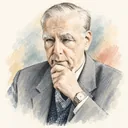
Illustrated portrait of Klaus von Klitzing

Klaus von Klitzing

Prize share · 1

Von Klitzing discovered the integer quantum Hall effect: under suitable conditions, Hall resistance takes plateau values h/(νe²), with integer ν. Hall voltage is measured across the current direction; this resistance differs from longitudinal resistance along the current. The reproducible relation became a foundation for precise resistance standards. He received the full Physics Prize.

Read the biography ↗

03 · Years in the making

The path here

  1. 1980

    Discovery in a silicon transistor at Grenoble; paper with Dorda and Pepper.

  2. 1985

    Von Klitzing receives the full Physics Prize, affiliated with Stuttgart.

  3. 1990

    Quantum Hall resistance enters conventional electrical standards.

  4. 2019

    The revised SI fixes h and e, linking resistance references to fundamental constants.

04 · Read further

From the original sources

Original explanations by Curionode, based on the official records below. Biographical details and affiliations refer to the award year.

  1. Official announcement nobelprize.org
  2. Original quantum Hall paper (1980): abstract and authors journals.aps.org
  3. NIST review: quantum Hall resistance and the revised SI tsapps.nist.gov