A life in context
The person behind the prize
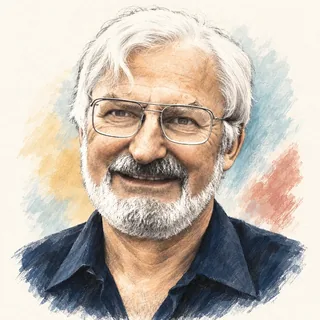
Binnig grew up in Frankfurt and Offenbach, with interests in music and physics. His studies and experimental research at Frankfurt led toward superconductivity. In 1978 he joined IBM’s Zurich laboratory, where discussions with Heinrich Rohrer developed into a new way to investigate surfaces locally. The team, including Christoph Gerber and Edmund Weibel, had to control vibration, tip shape and extremely small movements. Their instrument demonstrated vacuum tunnelling in 1981 and opened a new approach to atomic-scale surface imaging.
The contribution
Binnig co-invented the scanning tunnelling microscope with Rohrer. A voltage between a sharp conducting tip and a surface enables tunnelling current across a small gap. Feedback and precise scanning turn this sensitive signal into a surface map. It reflects electronic structure as well as geometry, rather than being an ordinary photograph of atoms. He received one quarter of the Physics Prize.
The idea in plain language
An electron microscope forms an image using an electron beam and electron-optical lenses. Ruska and Knoll built an early prototype in 1931; Ruska’s 1933 instrument surpassed contemporary light-microscope resolution. Magnetic lenses, vacuum equipment and subsequent engineering made the method useful for investigating very small structures.
Read the full award story ↗