01 · The discovery
The idea, in everyday language
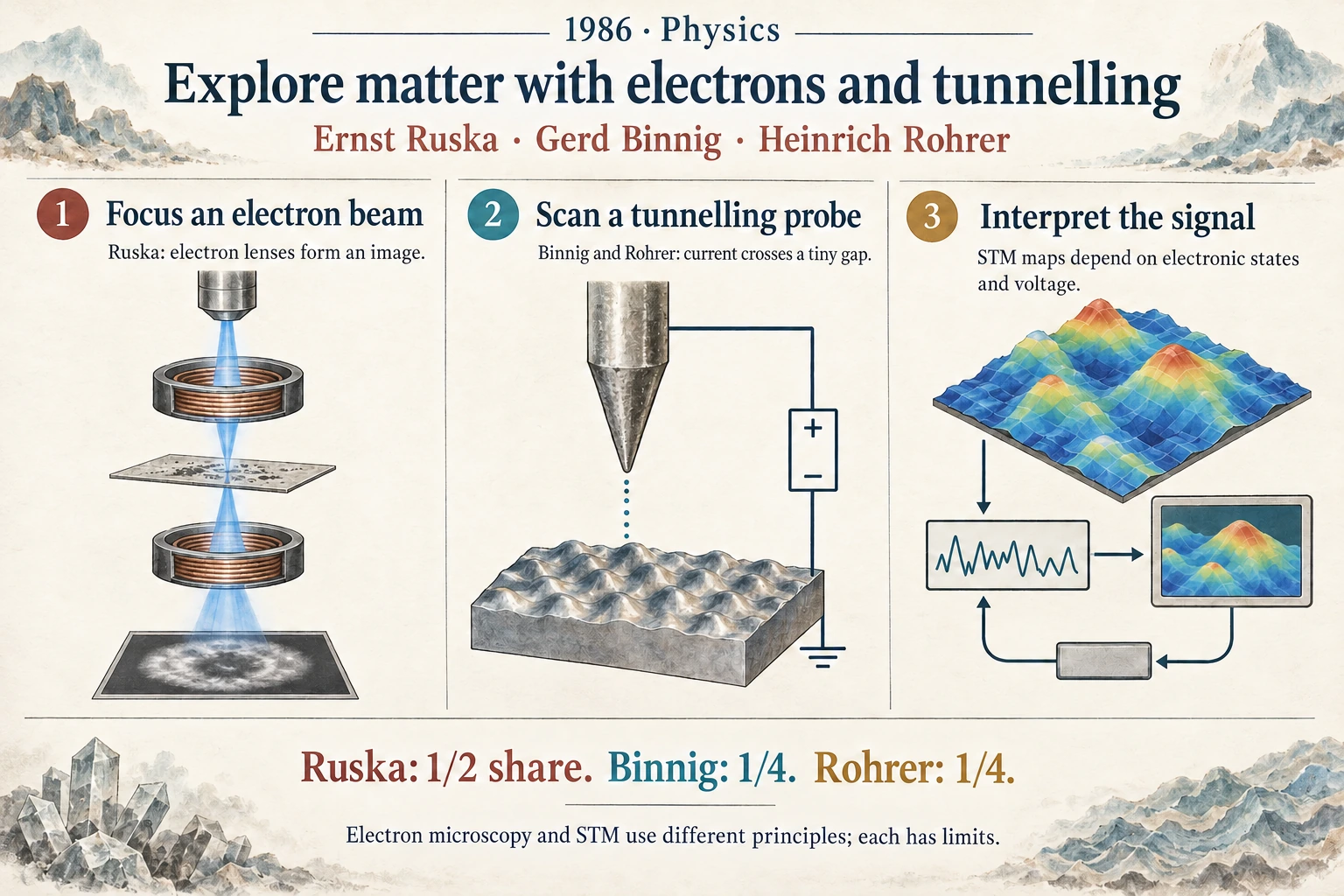
An electron microscope forms an image using an electron beam and electron-optical lenses. Ruska and Knoll built an early prototype in 1931; Ruska’s 1933 instrument surpassed contemporary light-microscope resolution. Magnetic lenses, vacuum equipment and subsequent engineering made the method useful for investigating very small structures.
The scanning tunnelling microscope uses a sharp conducting tip close to a conducting surface. An applied voltage allows a small tunnelling current across the gap. Its sensitivity to separation enables feedback-controlled scanning. Binnig and Rohrer’s team demonstrated vacuum tunnelling in 1981. The recorded signal depends on electronic states and voltage as well as surface geometry.
Why it matters
The prize recognised two routes to exploring matter at small scales. Electron microscopy transformed structural investigation, while STM opened local studies of surfaces and electronic properties. Ruska received one half; Binnig and Rohrer each received one quarter. Knoll, Gerber, Weibel and other collaborators also contributed to the developments.