A life in context
The person behind the prize
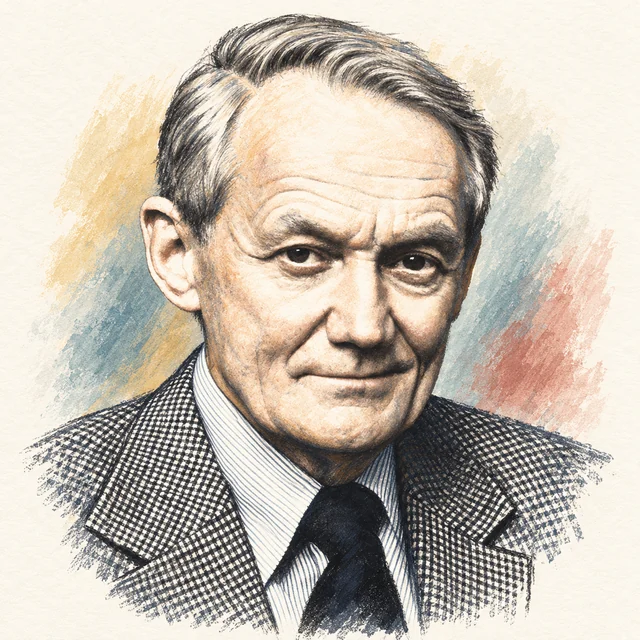
Siegbahn grew up in a physics family: his father Manne had received the 1924 Physics Prize for X-ray spectroscopy. Kai studied physics, mathematics and chemistry at Uppsala and completed his doctorate in Stockholm in 1944. He worked at the Nobel Institute for Physics, became professor at the Royal Institute of Technology in 1951, and moved to Uppsala in 1954. His group developed precise instruments and analysis for measuring electron energies. With collaborators including Carl Nordling and Eugene Sokolowski, he made small shifts in these energies useful for studying chemical environments. His work extended across atoms, molecules, solids and surfaces, with books that helped establish electron spectroscopy for chemical analysis as a research field.
The contribution
Siegbahn developed high-resolution electron spectroscopy, including ESCA, which infers electron binding energies and chemical environments from electrons emitted by a sample. He received one half of the Physics Prize. This is a different measurement from the laser spectroscopy recognised in the prize’s other half, and a separate award from his father’s 1924 prize.
The idea in plain language
Atoms and molecules exchange energy in characteristic ways, but a crowded or blurred spectrum can hide useful detail. Bloembergen developed nonlinear optical methods: strong light fields interact through matter and can produce new signals at combinations of their frequencies. Schawlow developed precision laser spectroscopy, including techniques with Hänsch that reduce broadening caused by atomic motion. Narrow, tunable laser light made transitions easier to distinguish.
Read the full award story ↗