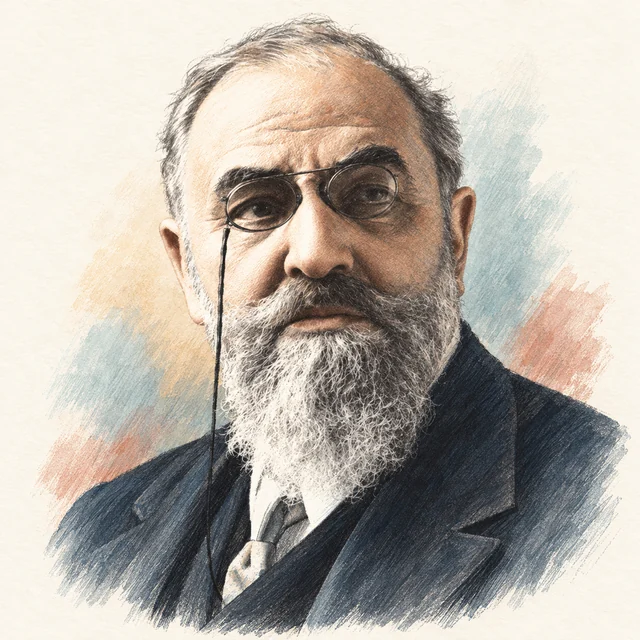
A life in context
The person behind the prize
Bourgeois trained in law after serving during the Franco-Prussian War and built a long career in French public administration and politics. His responsibilities included education and justice, and he briefly headed a government in 1895–1896. His concern with social cooperation extended to relations among states. At the Hague Peace Conferences of 1899 and 1907, he worked for arbitration and peaceful settlement. The 1899 conference established the Permanent Court of Arbitration, a result involving several delegations rather than one founder. During and after the First World War he argued for a permanent international organisation, serving on the commission that drafted the League of Nations Covenant in 1919. He favoured stronger common authority than the eventual compromise provided. In 1920 he became president of the French Senate and the first president of the League Council. The full Peace Prize recognised sustained work for peace and justice and his role in establishing the League. Poor health prevented him from attending the presentation. The surviving public ceremony remarks record that the French minister, Pralon, accepted for him. He died near Épernay in 1925. His achievement was to help create and use institutions for negotiation and law; their existence did not guarantee that states would avoid war.
The contribution
Bourgeois received the full Peace Prize for work for peace and justice and a prominent role in establishing the League of Nations. He promoted arbitration at The Hague and helped develop permanent institutions for cooperation among states.
The idea in plain language
If states have no agreed way to address a dispute, each crisis begins again with pressure and threats. Bourgeois argued for institutions through which governments could use discussion, law and arbitration. At the Hague Peace Conferences he helped promote peaceful settlement, including the 1899 creation of the Permanent Court of Arbitration.
Read the full award story ↗

