A life in context
The person behind the prize
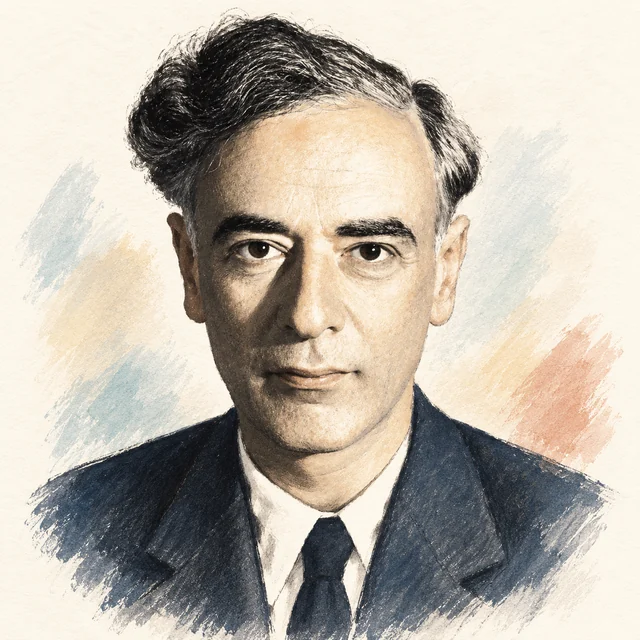
Landau graduated from Leningrad University in 1927 and began research at its Physico-Technical Institute. During 1929–1931 he worked abroad, particularly with Bohr in Copenhagen. He led theoretical work in Kharkov from 1932 to 1937, then joined Moscow’s Institute for Physical Problems under Kapitsa. His contributions ranged across theoretical physics, including magnetism, phase transitions and quantum liquids. Work in 1941 and 1947 treated the collective excitations of superfluid helium-4; his 1956–1958 Fermi-liquid theory addressed liquid helium-3. He also taught and co-authored the theoretical-physics course with Lifshitz. The prize emphasised condensed matter, especially liquid helium. Recovering from a serious 1962 accident, he received the prize in Moscow rather than attending Stockholm.
The contribution
Landau developed pioneering theories of condensed matter, especially quantum liquid helium, and received the full Physics Prize.
The idea in plain language
Liquid helium behaves in ways ordinary fluid models cannot explain. In helium-4 at sufficiently low temperatures, superfluid flow becomes possible. Experiments by Kapitsa and others posed questions about motion, heat and the liquid’s excitations.
Read the full award story ↗

