A life in context
The person behind the prize
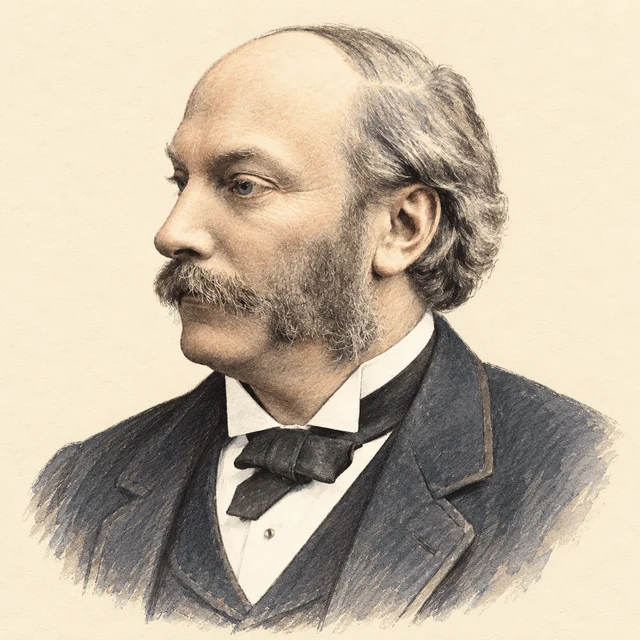
John William Strutt studied at Trinity College, Cambridge, entering in 1861 and graduating as Senior Wrangler in 1865. He became a fellow the next year. In 1871 he married Evelyn Balfour, and in 1873 inherited the title of third Baron Rayleigh. Work at the family estate at Terling combined theoretical analysis with carefully designed experiments. His two-volume Theory of Sound appeared in 1877–1878, and in 1879 he succeeded James Clerk Maxwell as Cavendish Professor at Cambridge. He returned to Terling in 1884 and later held a natural-philosophy appointment at the Royal Institution. His research ranged across sound, optics, electricity and the physical properties of gases. The problem recognised by the 1904 Nobel Prize began with a small but persistent discrepancy: nitrogen prepared from atmospheric air was denser than nitrogen obtained from chemical compounds. Repeated measurements and changes of preparation made the difference difficult to dismiss as an ordinary experimental error. The explanation was not that nitrogen atoms from different sources had different weights. The atmospheric sample contained an additional gas. Rayleigh and the chemist William Ramsay pursued complementary investigations, identifying argon in 1894 and studying its properties. Rayleigh received the full Physics Prize for investigations of important gas densities and the connected discovery of argon; Ramsay received a separate full Chemistry Prize. They did not divide one prize between them. Rayleigh’s wider scientific reputation included work on the scattering of light, but the blue colour of the sky was not the specific subject of this award. He served as president of the Royal Society from 1905 to 1908 and died in 1919. His career illustrates how a result that initially looks like an inconvenient discrepancy can become evidence for an unsuspected constituent of nature, when measurement is joined to persistent checking and collaboration.
The contribution
Rayleigh received the full Physics Prize for precise investigations of gas densities and the discovery of argon connected with them. His measurements helped reveal that atmospheric nitrogen was not a chemically pure sample.
The idea in plain language
Comparing gas densities requires attention to the amount of gas, temperature, pressure and impurities. Rayleigh’s repeated measurements produced a small difference between samples that were expected to be the same substance. Checking the sources and preparation methods made the discrepancy a durable clue rather than an isolated reading.
Read the full award story ↗

