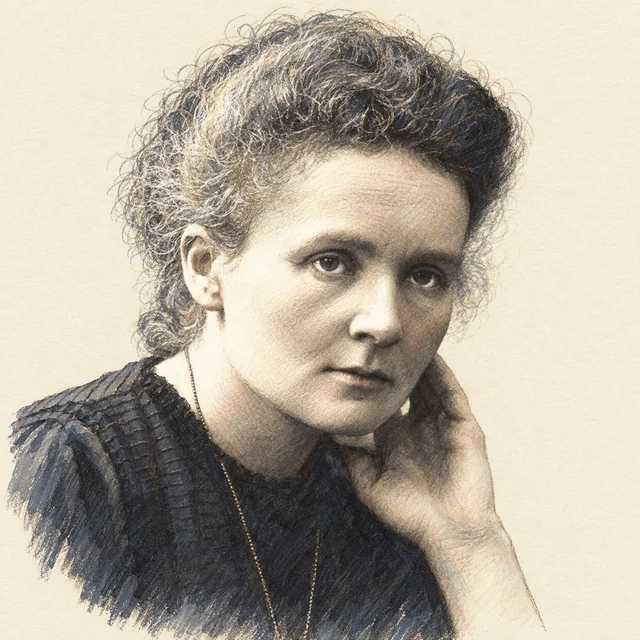
A life in context
The person behind the prize
Marie Skłodowska was born in Warsaw and worked as a governess before going to Paris in 1891 to study at the Sorbonne. She married Pierre Curie in 1895. Following Henri Becquerel’s discovery of uranium radiation, she investigated the activity of minerals and used it as evidence for substances not yet identified chemically. Marie and Pierre announced polonium and radium in 1898; separating and characterising radium required years of demanding chemical work. She completed her doctorate in 1903 and shared that year’s Physics Prize with Pierre and Becquerel, receiving one quarter of the total. Pierre died in 1906. Marie took over his laboratory and began teaching his course that year, becoming a full professor in 1908. In 1910 she isolated radium metal with André Debierne. The full 1911 Chemistry Prize recognised the elements and her work on radium and its compounds, making her the first person to receive a second Nobel Prize. During the First World War she helped organise radiography services and training, work involving X-rays rather than the discovery of them. She later directed research at the Radium Institute. She died in 1934; her daughter Irène shared the 1935 Chemistry Prize with Frédéric Joliot. Her biography connects the two Nobel awards without turning their different contributions into a single prize.
The contribution
Curie received the full 1911 Chemistry Prize for the discovery of radium and polonium, the isolation of radium and study of its nature and compounds. Her chemical separations and measurements established new elements; this differs from her shared 1903 Physics award for radiation research.
The idea in plain language
Becquerel’s discovery of uranium radiation in 1896 opened the question of which substances emit it. Marie Curie compared minerals and compounds. When a sample was more active than its known constituents predicted, that suggested an additional radioactive substance. Chemical separation could then concentrate activity into particular fractions, guiding the search for something present in very small amounts. Activity was a clue to composition, rather than a new element being manufactured by the separation.
Read the full award story ↗

