A life in context
The person behind the prize
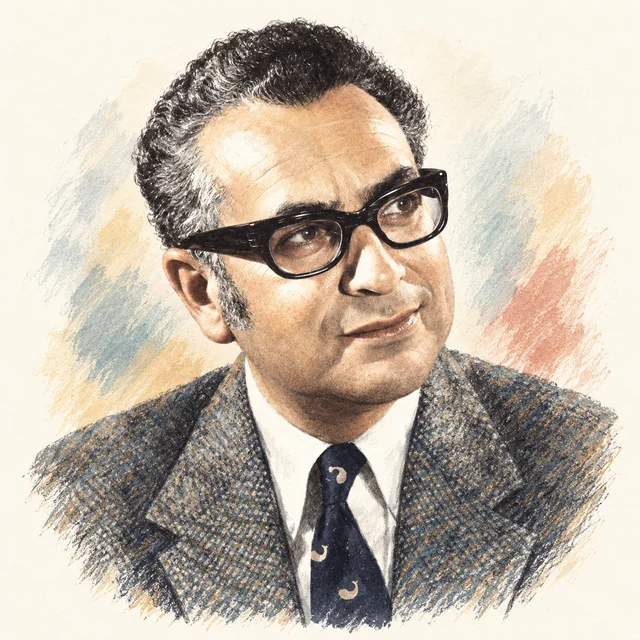
Gell-Mann earned his Yale degree in 1948 and MIT doctorate in 1951. After research at the Institute for Advanced Study and the University of Chicago, he joined Caltech in 1955, according to the later addendum to his Nobel biography. His work sought order among the growing number of particles revealed by experiments. Strangeness helped describe otherwise puzzling production and decay behaviour. The Eightfold Way, introduced in 1961, organised strongly interacting particles using mathematical symmetry. Its patterns supported predictions of missing members. In 1964 he proposed quarks as constituents of hadrons; George Zweig independently proposed a related account. The award recognised classification and interactions more broadly. Later quantum chromodynamics and his Santa Fe work on complexity belong to subsequent chapters of his career. Caltech was his award-year affiliation.
The contribution
Gell-Mann developed methods for classifying particles and understanding their interactions. He received the full Physics Prize.
The idea in plain language
Strangeness helped describe particles whose production and decay had seemed inconsistent. The Eightfold Way used symmetry to organise related hadrons, the strongly interacting particle families that include protons, neutrons and mesons.
Read the full award story ↗

