01 · The discovery
The idea, in everyday language
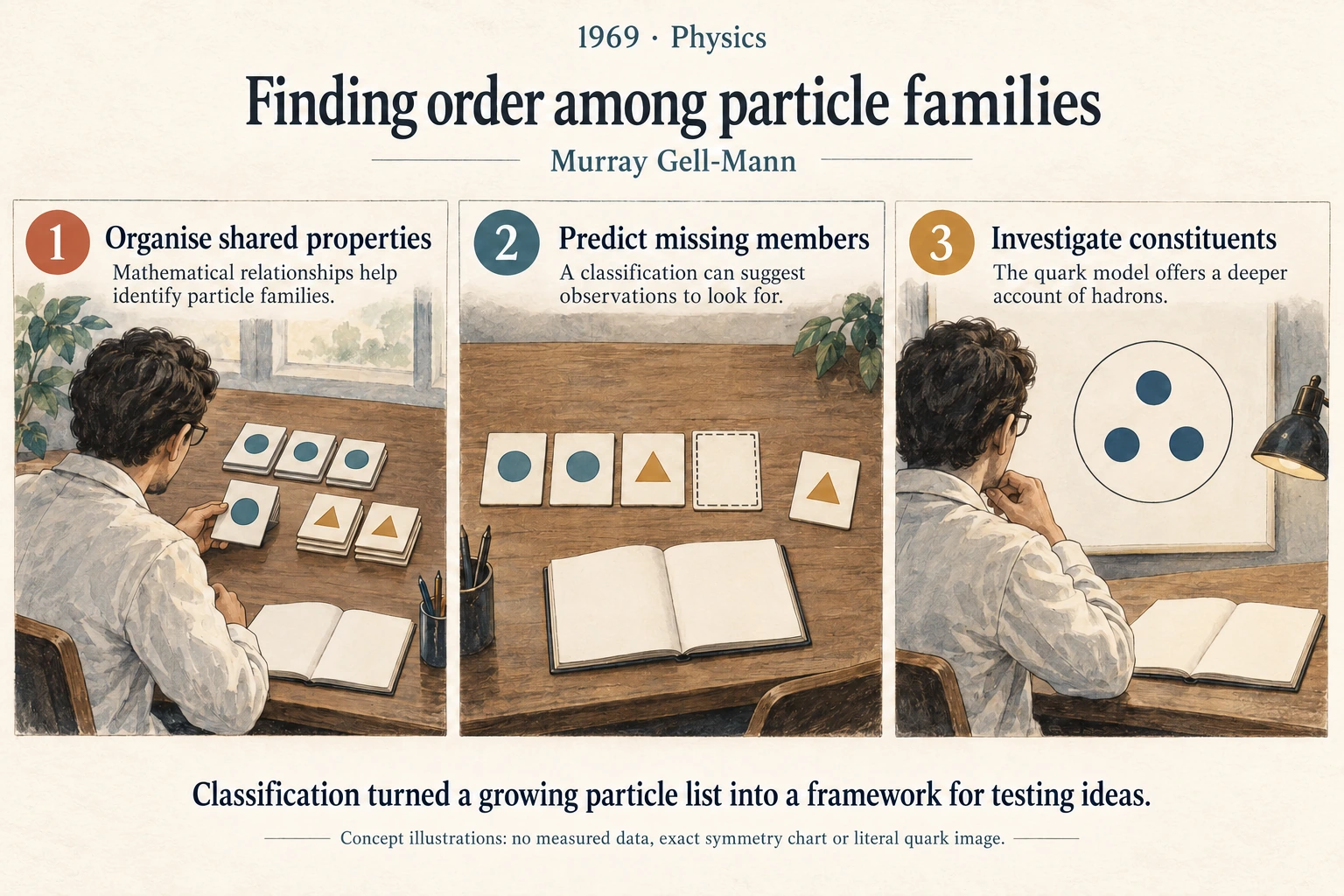
Strangeness helped describe particles whose production and decay had seemed inconsistent. The Eightfold Way used symmetry to organise related hadrons, the strongly interacting particle families that include protons, neutrons and mesons.
A useful classification could make testable predictions. Gell-Mann predicted the omega-minus baryon in 1962. His 1964 quark proposal offered constituents for hadrons; Zweig independently pursued a related model. The prize recognised a broader body of work on classification and interactions.
Why it matters
The work gave researchers powerful methods for relating particle properties, interactions and new observations. It helped replace a growing list with a framework that could be examined and tested.