01 · The discovery
The idea, in everyday language
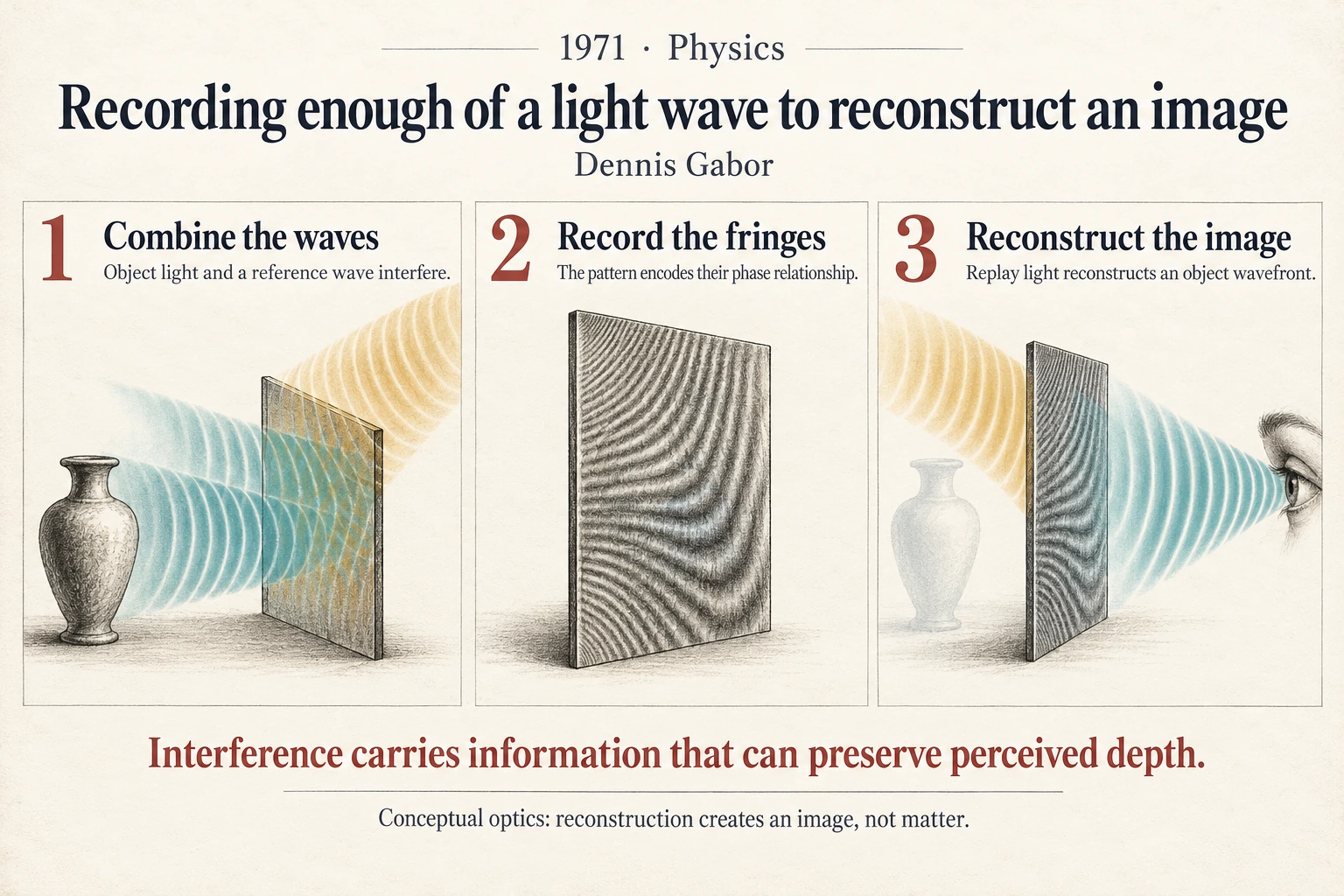
Light reflected from an object carries both amplitude and phase information. Combining it with a coherent reference wave produces interference fringes on a recording plate. The phase relationship influences that recorded intensity pattern; it is not a tiny conventional picture of the object.
Illuminating the developed hologram appropriately diffracts light into a reconstructed wavefront. An observer can perceive depth because that wavefront carries spatial information. Gabor’s optical experiments and 1948–1951 papers established the method. Lasers from 1960 and later work by other researchers greatly expanded its practical use.
Why it matters
Holography opened new possibilities for imaging and interference-based measurement of shape or vibration. It connected the recording of light with reconstruction of a wavefront, extending the information available beyond a conventional intensity photograph.