A life in context
The person behind the prize
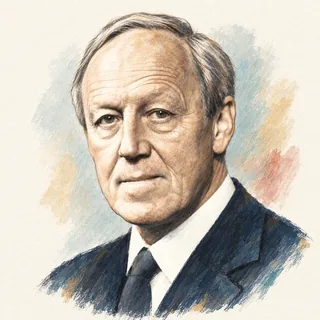
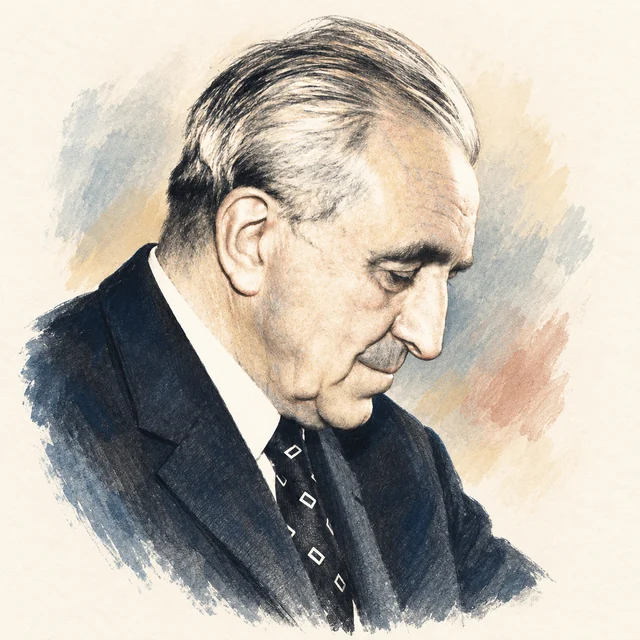
Néel studied at the École Normale Supérieure in Paris, then pursued magnetism in Pierre Weiss’s Strasbourg laboratory. He completed a doctorate in 1932 and became a Strasbourg professor in 1937. During the war he investigated protection against magnetic mines and moved his work to Grenoble. He became a professor there in 1945 and directed a CNRS laboratory from 1946, helping develop Grenoble’s research institutions. His theoretical investigations showed how opposing magnetic sublattices could produce antiferromagnetic order, and how unequal opposing contributions could leave a net ferrimagnetic moment. This helped explain ferrite materials that had resisted earlier accounts. Other work examined domains, small grains and hysteresis. His official 1970 affiliation was the University of Grenoble. The prize recognised fundamental magnetic order and solid-state applications, independently of Alfvén’s plasma studies. Opposing moments represent an ordered state, rather than an absence of microscopic magnetism.
The contribution
Néel developed fundamental descriptions of antiferromagnetism and ferrimagnetism with important solid-state applications. He received half the Physics Prize.
The idea in plain language
A plasma contains charged particles and can conduct electric current. Alfvén examined how fluid motion, currents and fields influence one another, developing magnetohydrodynamics and the waves associated with his name. This brought useful physical tools to problems in space and in laboratory plasmas.
Read the full award story ↗