A life in context
The person behind the prize
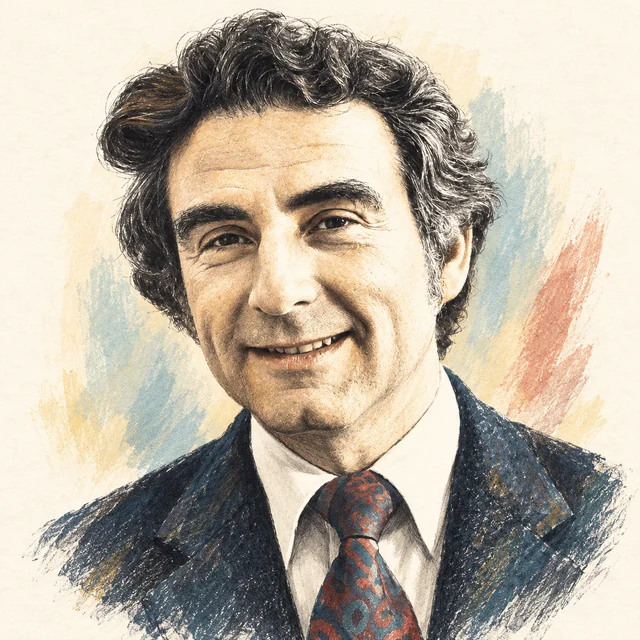
Cooper studied at Columbia, receiving a bachelor’s degree in 1951 and doctorate in 1954. After the Institute for Advanced Study, he joined Illinois as a research associate in 1955. His 1956 paper investigated how an effective attraction could produce a bound pair of electrons above a filled Fermi sea. That model was an important step toward the many-electron theory developed with Bardeen and Schrieffer in 1957. It was not by itself a complete description of every interacting electron in a superconductor. Cooper worked at Ohio State before joining Brown in 1958. Later he moved into neural science and learning, including a Brown centre founded in 1973. The 1972 prize recognised superconductivity, not those later brain studies; his award-year affiliation was Brown.
The contribution
Cooper’s electron-pairing result helped establish the microscopic basis of the joint BCS theory. He received one third of the Physics Prize.
The idea in plain language
In the lattice-based mechanism described by the 1972 announcement, electron interactions with crystal vibrations can provide an effective attraction. Cooper’s 1956 model showed how a bound pair could arise above a filled Fermi sea. A pair here is a quantum correlation, not two charged balls glued together or a tiny isolated molecule.
Read the full award story ↗