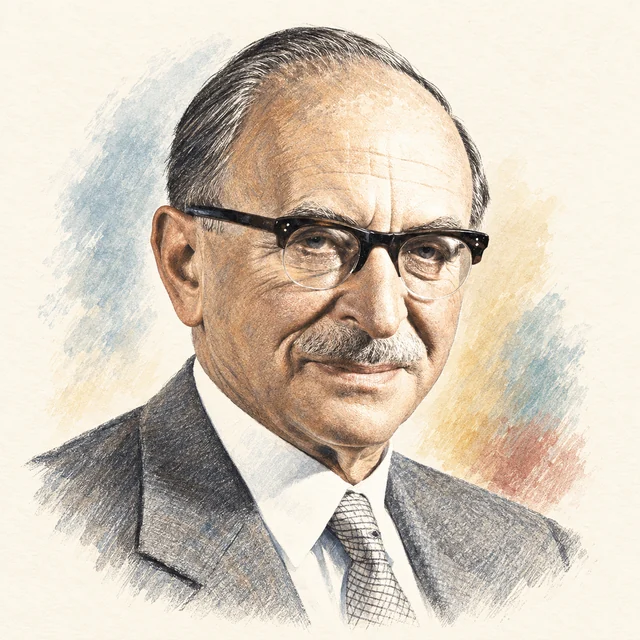
A life in context
The person behind the prize
Gabor became fascinated by physics as a teenager, but trained in electrical engineering in Berlin, receiving a diploma in 1924 and doctorate in 1927. Work at Siemens included electron optics and discharge lamps. Leaving Germany in 1933, he eventually joined British Thomson-Houston in Rugby. His attempt to improve electron microscopy led to optical experiments in wavefront reconstruction in 1948. Papers from 1948–1951 developed the holographic method; its practical possibilities expanded after lasers became available. Gabor joined Imperial College in 1949, later becoming professor of applied electron physics. After retirement in 1967 he remained a senior research fellow and also worked with CBS Laboratories in the United States. His award-year affiliation was Imperial College. The prize recognised the invention and development of holography, not an invention of the laser or the physical recreation of objects. His autobiography also describes an increasing interest in the social consequences of technology.
The contribution
Gabor invented and developed the holographic method, recording and reconstructing wavefront information. He received the entire Physics Prize.
The idea in plain language
Light reflected from an object carries both amplitude and phase information. Combining it with a coherent reference wave produces interference fringes on a recording plate. The phase relationship influences that recorded intensity pattern; it is not a tiny conventional picture of the object.
Read the full award story ↗

