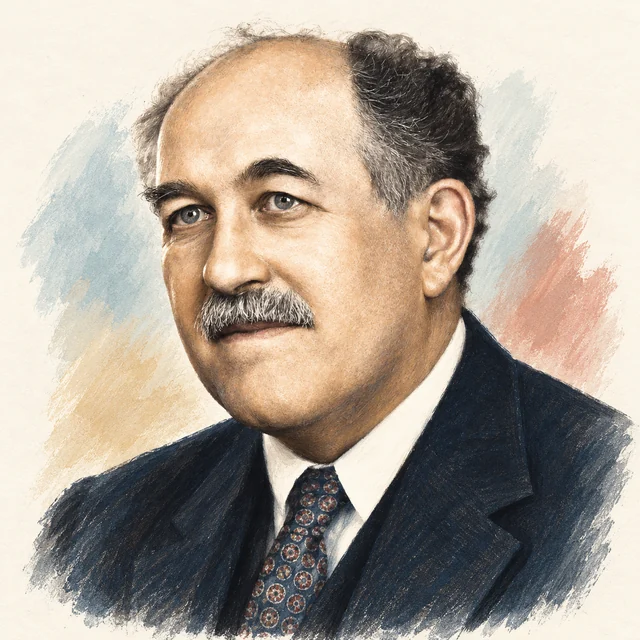
A life in context
The person behind the prize
Stern trained in physical chemistry, receiving his doctorate at Breslau in 1912, and then worked with Albert Einstein in Prague and Zurich. His early theoretical interests included thermodynamics and quantum theory. At Frankfurt he turned increasingly toward experiment, developing the molecular-beam method as a way to measure isolated atoms and molecules. In 1922 he and Walter Gerlach observed the splitting of a silver-atom beam in a non-uniform magnetic field, giving striking evidence for quantized magnetic behaviour. As a professor and laboratory director in Hamburg from 1923, Stern developed a much broader programme of beam research. With colleagues including Immanuel Estermann and Otto Robert Frisch, he investigated the proton’s magnetic moment, finding in 1933 that it differed substantially from a simple theoretical expectation. Nazi persecution forced him to leave Germany in 1933; he continued his research at Carnegie Institute of Technology in Pittsburgh. The whole 1943 Physics Prize recognised both his development of the beam method and the proton result. Reserved in 1943, it was announced in November 1944, with presentation remarks broadcast that December.
The contribution
Stern received the whole Physics Prize for developing the molecular-ray method and discovering the proton’s magnetic moment. The work included important contributions from collaborators.
The idea in plain language
How can the magnetic properties of a particle far too small to see become measurable? A narrow beam of isolated atoms or molecules lets investigators connect microscopic properties with the beam’s observable motion. Stern developed and refined this approach rather than treating a substance only as a bulk sample.
Read the full award story ↗

