A life in context
The person behind the prize
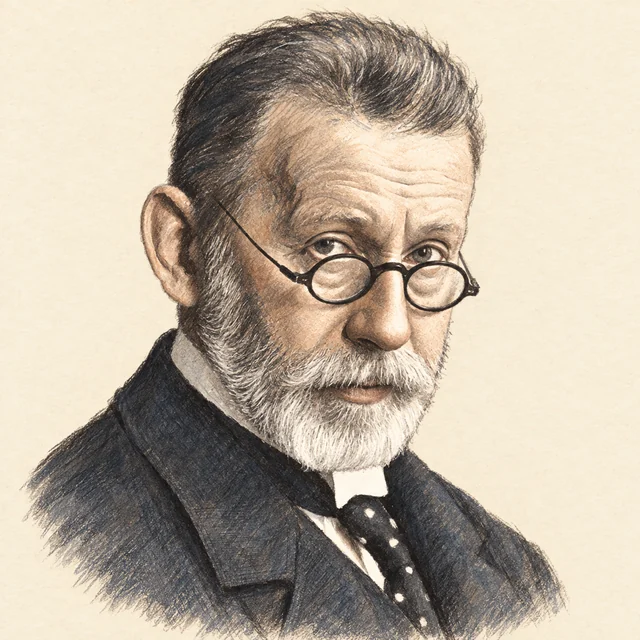
Paul Ehrlich studied medicine in several German universities and completed his medical doctorate in Leipzig in 1878. His fascination with dyes became a way to distinguish cells and ask why particular chemicals attach to particular biological structures. Work in Berlin connected staining methods, blood cells and infectious disease. He later investigated antitoxins and the measurement of protective serum, helping turn an apparently similar bottle of serum into a preparation whose activity could be compared by a standard. His side-chain theory proposed that specific chemical affinities could explain how a cell interacted with a toxin and how antitoxins arose. This was a historical model, not the complete modern account of antibody production. In 1896 Ehrlich became director of the new serum research and testing institute at Steglitz; it moved to Frankfurt in 1899. He also became the first director of the Georg-Speyer-Haus when it opened in 1906, while continuing to lead the Royal Institute for Experimental Therapy. Ehrlich shared the 1908 Medicine Prize equally with Mechnikov for work on immunity. His later research with Alfred Bertheim and Sahachirō Hata led to Salvarsan in 1909, a distinct development in chemotherapy rather than the reason for the 1908 award. The idea of a selectively acting drug did not mean that every treatment would be harmless. Ehrlich died in Bad Homburg in 1915. His legacy also faced political attack: in 1935, under the Nazi regime, his writings were removed from the institute’s library, and Jewish staff were dismissed. The later attempt to erase his name contrasts with the lasting importance of his experimental work on specific biological recognition and measurable serum activity.
The contribution
Ehrlich received half the Medicine Prize for work on immunity. Experiments on antitoxins, serum potency and specific chemical binding helped explain and measure protection carried by substances in body fluids.
The idea in plain language
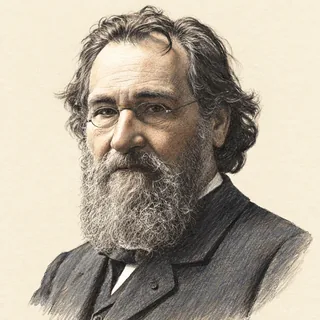
Mechnikov’s observations connected mobile cells with defence. Cells could surround, engulf and digest foreign particles or microbes, a process called phagocytosis. Studies of small animals helped turn inflammation from a mere sign of disease into a question about protective cellular activity, although some microbes could resist destruction.
Read the full award story ↗