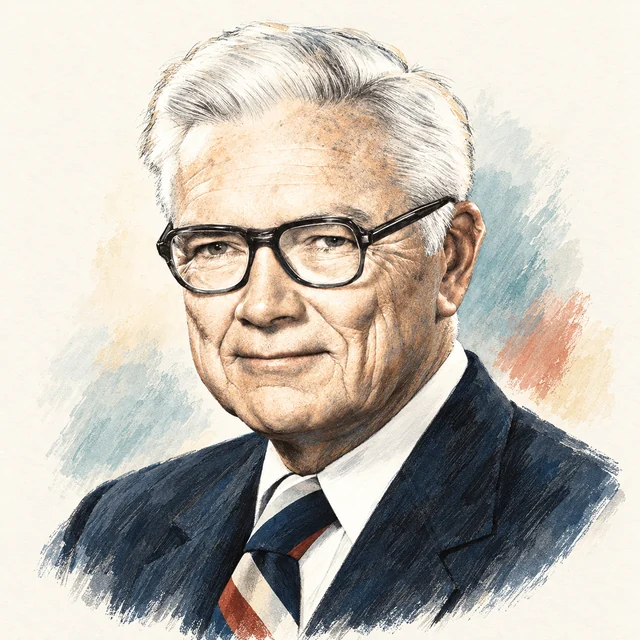
A life in context
The person behind the prize
Flory graduated from Manchester College in 1931 and completed a physical-chemistry doctorate at Ohio State in 1934. Joining DuPont, he worked with Wallace Carothers and became interested in the foundations of polymer formation. Later industrial work on synthetic rubber let him continue basic research alongside urgent wartime demands. He joined Cornell in 1948, and his lectures grew into Principles of Polymer Chemistry, published in 1953. Statistical descriptions of chain shape, excluded-volume effects and experiments on solutions connected molecular structure with measurable properties. After a period at the Mellon Institute, he moved to Stanford in 1961. His 1969 book Statistical Mechanics of Chain Molecules organised another major part of this work. The prize recognised a broad combination of theory and experiment, rather than the invention of every plastic or one fixed shape for all polymers.
The contribution
Flory established theoretical and experimental foundations for understanding macromolecular chains, their formation and their physical behaviour. He received the entire Chemistry Prize.
The idea in plain language
A flexible molecular chain can adopt many configurations. Its typical size depends on chemical structure, chain length and how different segments interact with their surroundings. Segments cannot freely occupy the same physical space; solvent conditions can favour expanded or more compact configurations. Flory developed statistical accounts of these effects and connected them to measurable quantities such as viscosity, diffusion and light scattering.
Read the full award story ↗

