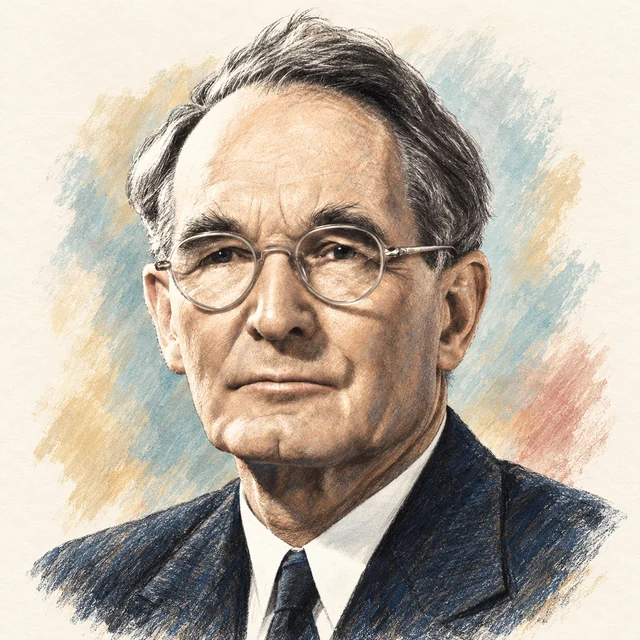
A life in context
The person behind the prize
Bridgman entered Harvard in 1900, receiving his AB in 1904, AM in 1905 and doctorate in physics in 1908. He joined the university’s faculty and became Hollis professor of mathematics and natural philosophy in 1926. His investigations of pressure began in 1905. Improving the containment of pressure opened an experimental range that had previously been difficult to reach, while careful calibration allowed him to study material behaviour rather than simply announce higher records. His work examined compressibility, electrical and thermal properties, viscosity and changes between different forms of a substance. He also wrote about scientific concepts and the relationship between a physical quantity and the operations used to investigate it, including The Logic of Modern Physics in 1927. Harvard was his affiliation for the full 1946 Physics Prize. His appointment as Higgins University Professor in 1950 came later. The award recognised both the apparatus and the discoveries it enabled, rather than every later development in high-pressure science.
The contribution
Bridgman developed apparatus for extremely high pressures and used it to discover changes in the structure and properties of matter. He received the full Physics Prize for the combination of experimental access and investigation.
The idea in plain language
A material’s familiar properties describe only part of its behaviour. What happens when the pressure rises far beyond ordinary conditions? Before Bridgman, leakage, containment and measurement restricted the range available for systematic investigation. His work from 1905 improved experimental access and made higher pressures useful for research.
Read the full award story ↗

