01 · The discovery
The idea, in everyday language
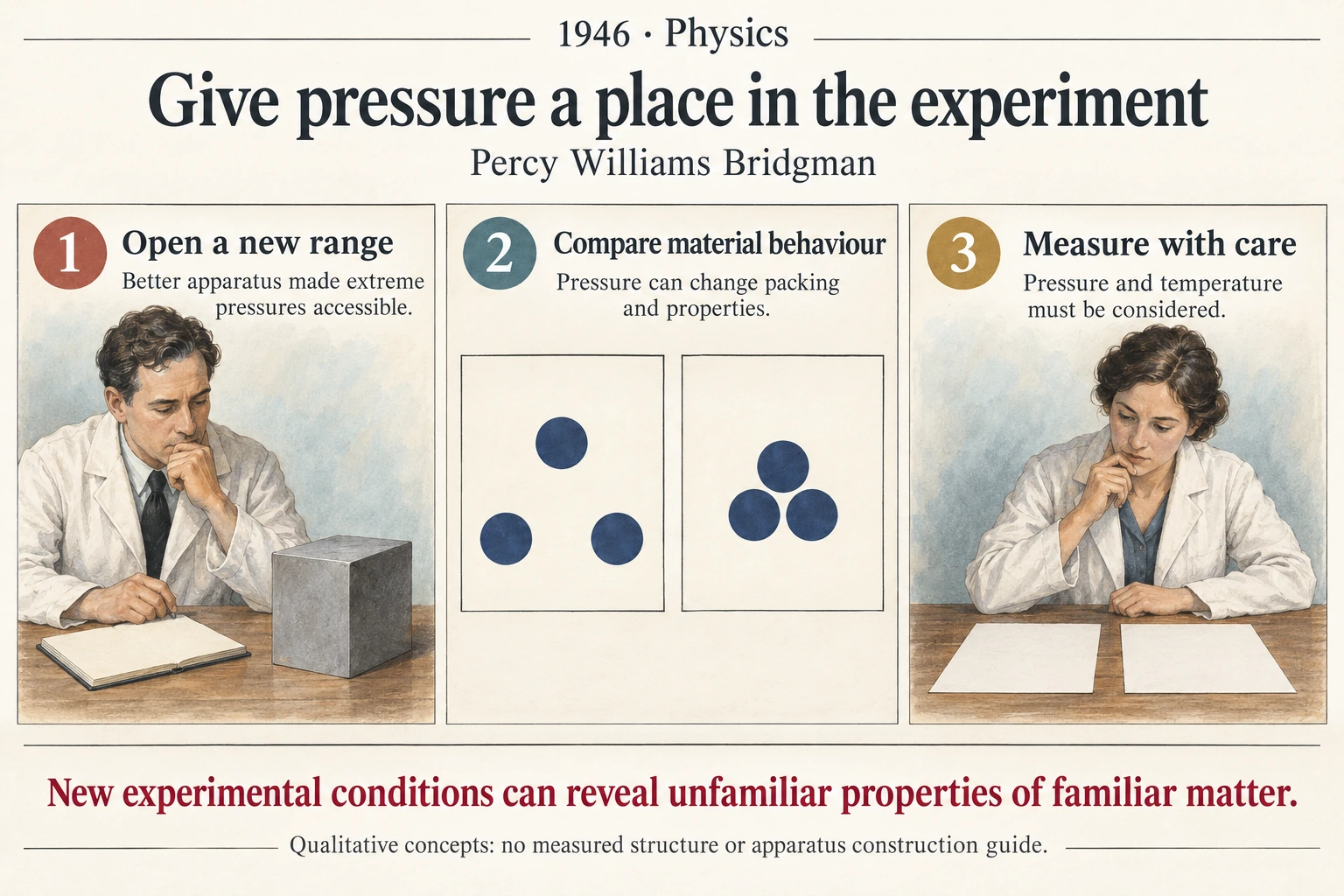
A material’s familiar properties describe only part of its behaviour. What happens when the pressure rises far beyond ordinary conditions? Before Bridgman, leakage, containment and measurement restricted the range available for systematic investigation. His work from 1905 improved experimental access and made higher pressures useful for research.
He then investigated compressibility, electrical resistance, thermal properties and changes between different forms of substances, including ice. The prize joined the enabling apparatus with the discoveries made using it. The contribution was a sustained programme of making conditions accessible, measuring them and comparing what materials do under those conditions.
Why it matters
High-pressure investigation extended physics into conditions that ordinary laboratory surroundings could not represent. It revealed that a substance can have different structures and physical properties depending on its environment, while providing data against which explanations could be tested. Calibration and materials research were part of making those observations reliable.