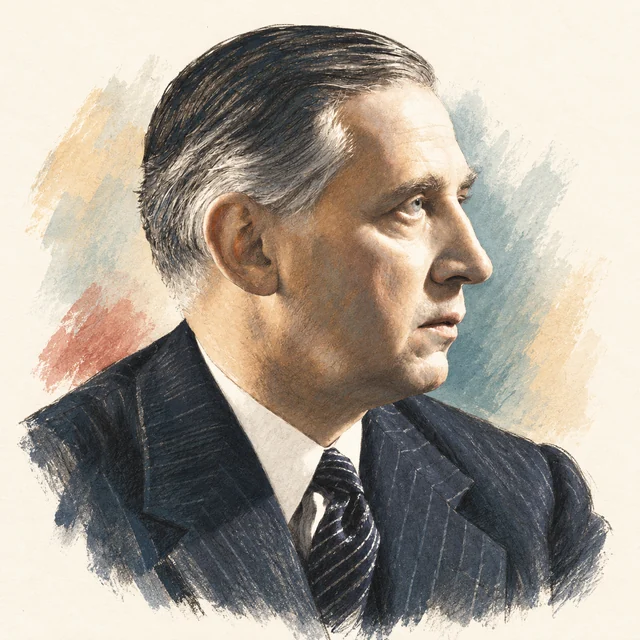
A life in context
The person behind the prize
Appleton studied natural sciences at Cambridge, completing the two parts of the Tripos in 1913 and 1914. War service introduced him to radio technology. He returned to Cambridge and became an assistant demonstrator at the Cavendish Laboratory in 1920. In 1924 he took a professorship in London and, with M. A. F. Barnett, used interference between ground waves and returning sky waves to investigate the upper atmosphere. Subsequent work distinguished a higher ionised region from the lower region already associated with Heaviside and Kennelly. He returned to a Cambridge chair in 1936 and became secretary of the Department of Scientific and Industrial Research in 1939. That department in London, rather than an earlier university post, was his affiliation for the full 1947 Physics Prize. His work helped connect radio observations with the changing electrical state of the upper atmosphere. The award recognised these investigations, especially the higher region; it did not make him the sole inventor of radio or radar.
The contribution
Appleton investigated the ionised upper atmosphere with radio waves, including the higher region associated with his name. He received the full Physics Prize; Barnett’s contribution to the 1924 interference work remains explicit.
The idea in plain language
Why could some radio signals travel far beyond the visible horizon? The electrically charged upper atmosphere provided a route that simple straight-line propagation did not explain. In 1924 Appleton and M. A. F. Barnett used interference between a wave travelling along the ground and one returning from above to establish evidence for a sky-wave path.
Read the full award story ↗

