c.curionodeThe Nobel Archive

1947 · Physics

Read the sky through returning radio waves

Appleton used radio observations to investigate the ionised upper atmosphere, especially a higher region that changed the picture of long-distance propagation.

IonosphereRadio propagationInterferenceUpper atmosphere
1947Physics

Visual guide

The prize, pictured

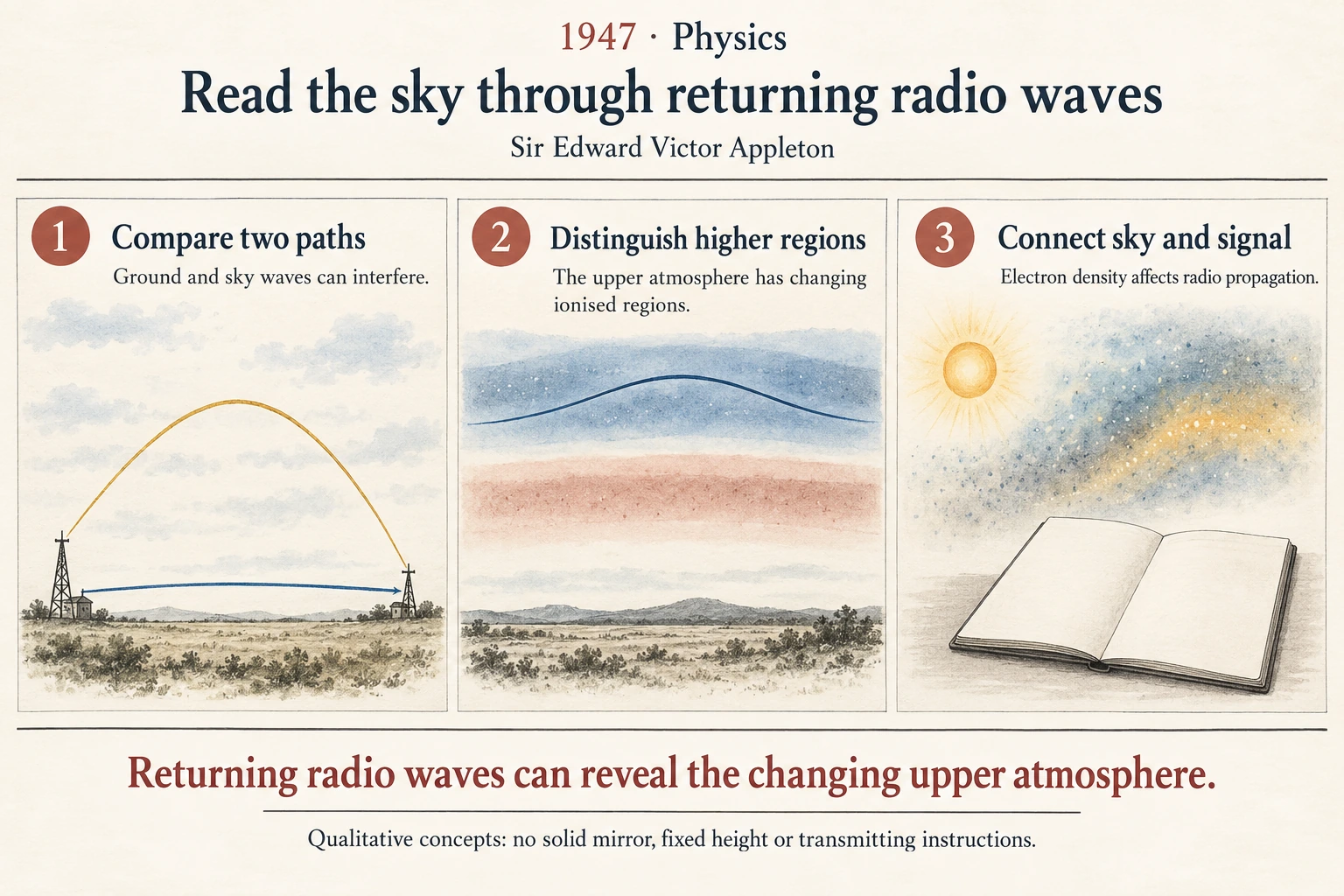
Infographic explaining Read the sky through returning radio waves
Original AI-generated infographic. A conceptual overview; the explanations and sources below provide context.
Read the poster text

Returning radio waves can reveal the changing upper atmosphere.

  1. Compare two paths

    Ground and sky waves can interfere.

  2. Distinguish higher regions

    The upper atmosphere has changing ionised regions.

  3. Connect sky and signal

    Electron density affects radio propagation.

Qualitative concepts: no solid mirror, fixed height or transmitting instructions.

01 · The discovery

The idea, in everyday language

Why could some radio signals travel far beyond the visible horizon? The electrically charged upper atmosphere provided a route that simple straight-line propagation did not explain. In 1924 Appleton and M. A. F. Barnett used interference between a wave travelling along the ground and one returning from above to establish evidence for a sky-wave path.

Further observations distinguished a higher ionised region from the lower E region. This higher F region became associated with Appleton’s name. Its behaviour helped connect radio reception with the state of the upper atmosphere and the Sun. The 1947 prize recognised this atmospheric physics, especially the higher region, rather than the invention of all wireless communication.

Why it matters

Radio waves became probes of an otherwise difficult-to-reach part of the atmosphere. Solar radiation ionises gases, and the resulting electron population affects propagation. Understanding those changes helped explain variations in reception and laid foundations for later ionospheric research.
02 · The people

Who brought the idea to life?

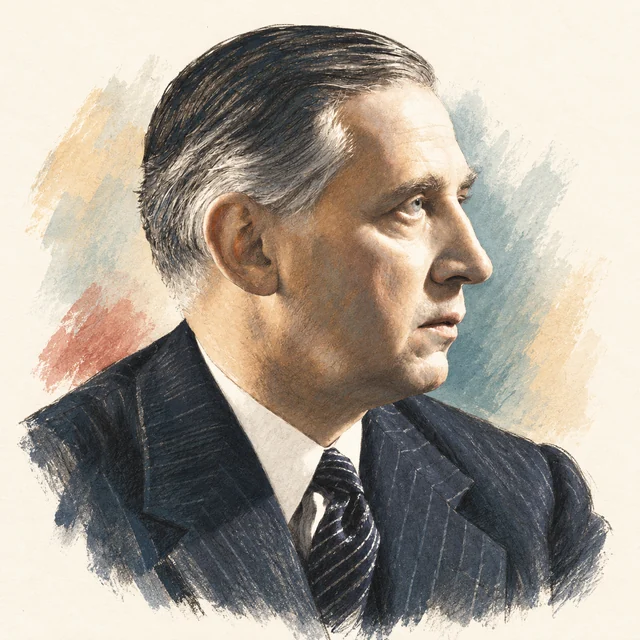
Illustrated portrait of Sir Edward Victor Appleton

Sir Edward Victor Appleton

Prize share · 1

Appleton investigated the ionised upper atmosphere with radio waves, including the higher region associated with his name. He received the full Physics Prize; Barnett’s contribution to the 1924 interference work remains explicit.

Read the biography ↗

03 · Years in the making

The path here

  1. 1920

    Becomes an assistant demonstrator at Cambridge’s Cavendish Laboratory.

  2. 1924

    With M. A. F. Barnett, investigates ground-wave and sky-wave interference.

  3. 1936

    Takes a chair at Cambridge.

  4. 1939

    Becomes secretary of the Department of Scientific and Industrial Research.

  5. 1947

    Receives the Physics Prize for upper-atmosphere investigations.

04 · Read further

From the original sources

Original explanations by Curionode, based on the official records below. Biographical details and affiliations refer to the award year.

  1. Official award summary nobelprize.org
  2. Award ceremony speech nobelprize.org
  3. NOAA: the ionosphere and radio propagation spaceweather.gov
  4. Official biography: Sir Edward Victor Appleton nobelprize.org