A life in context
The person behind the prize
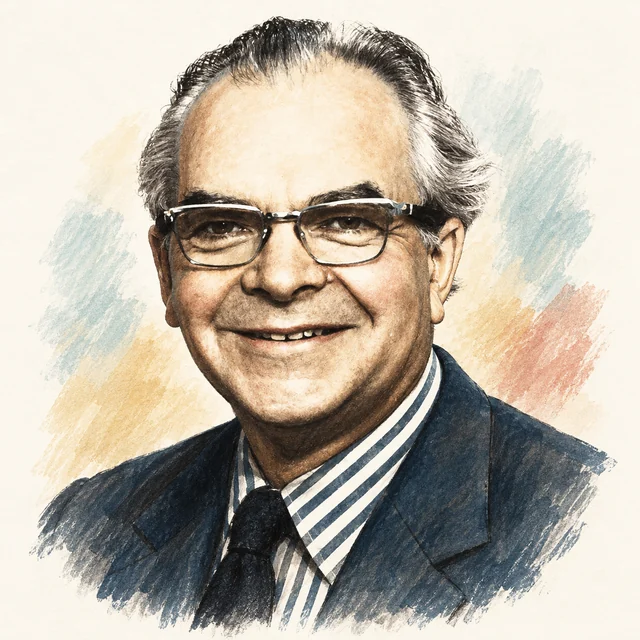
Mitchell studied natural sciences and biochemistry at Cambridge, beginning research with James Danielli in 1942. His doctorate in 1951 concerned penicillin’s action. In 1955 he moved to Edinburgh to lead a chemical-biology unit, developing ideas about metabolism and transport across membranes. His chemiosmotic theory, published in 1961, proposed that energy transfer could depend on an electrochemical proton gradient rather than a hypothetical chemical intermediate directly linking the enzymes. Ill health led him to leave Edinburgh in 1963. With Jennifer Moyle he adapted Glynn House in Cornwall into a small independent laboratory; research there began in 1965. Their experiments and work by many other laboratories tested and refined the initially disputed theory. The prize recognised the conceptual explanation of biological energy transfer, not sole authorship of every later ATP-synthase mechanism.
The contribution
Mitchell received the full Chemistry Prize for formulating chemiosmotic theory. A membrane can couple energy-releasing processes to ATP synthesis through an electrochemical proton gradient. Jennifer Moyle and many other researchers contributed to testing and developing the account.
The idea in plain language
Electron-transfer reactions can drive the movement of protons across a membrane. The resulting difference combines an electrical potential with a difference in proton chemical activity. Keeping the two sides separated allows energy from those reactions to be stored in this electrochemical gradient.
Read the full award story ↗

