A life in context
The person behind the prize
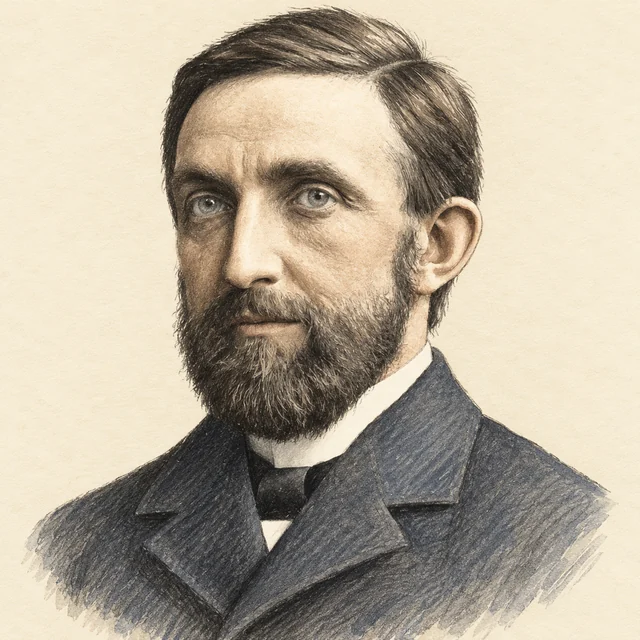
Philipp Lenard studied physics in several European cities and completed his doctorate at Heidelberg in 1886. Experiments on luminescence and cathode rays became major interests. In 1892 he went to Bonn as an assistant to Heinrich Hertz. Hertz had observed that cathode rays could pass through thin metal foil and suggested separating the region in which the rays were produced from another space in which they could be studied. Lenard developed a discharge tube with a thin aluminium window, publishing the work in 1894. The window allowed the rays to emerge beyond the tube, where their scattering, absorption, electrical effects and ability to cause fluorescence could be investigated. It was an inventive experimental arrangement, not the first observation of cathode rays themselves. The interpretation developed through the work of many investigators: the rays were streams of negatively charged electrons, distinct from X-rays or ordinary electromagnetic radiation. Lenard also investigated the photoelectric effect and the behaviour of electrons with different energies. These experiments belong to the background of quantum physics, while Einstein’s explanation of the photoelectric law was a separate contribution. Lenard became a professor at Kiel in 1898 and received the full 1905 Physics Prize for his work on cathode rays. He returned to Heidelberg in 1907 and retired in 1931. His later public conduct is inseparable from a critical account of his career. He promoted antisemitic attacks on Jewish physicists, supported National Socialism and became a leading advocate of the racial ideology called Deutsche Physik. Heidelberg’s own institutional history records his exclusion of Jewish colleagues from events. Scientific achievement offers no justification for that discrimination. Lenard died at Messelhausen in 1947. His career therefore combines important experimental techniques with an enduring example of how scientific authority can be used to support racist political exclusion.
The contribution
Lenard received the full Physics Prize for work on cathode rays. His thin aluminium window made it possible to study their behaviour outside the discharge tube, extending experimental electron research.
The idea in plain language
Following Hertz’s observation that cathode rays could pass through thin metal foil, Lenard developed a window that maintained the separation between the tube and an external region. This arrangement made it possible to study the rays beyond their source.
Read the full award story ↗

