A life in context
The person behind the prize
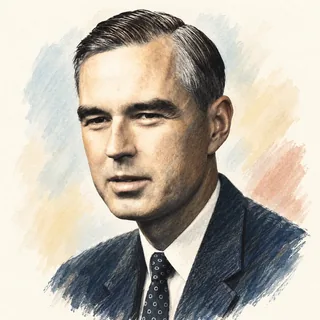
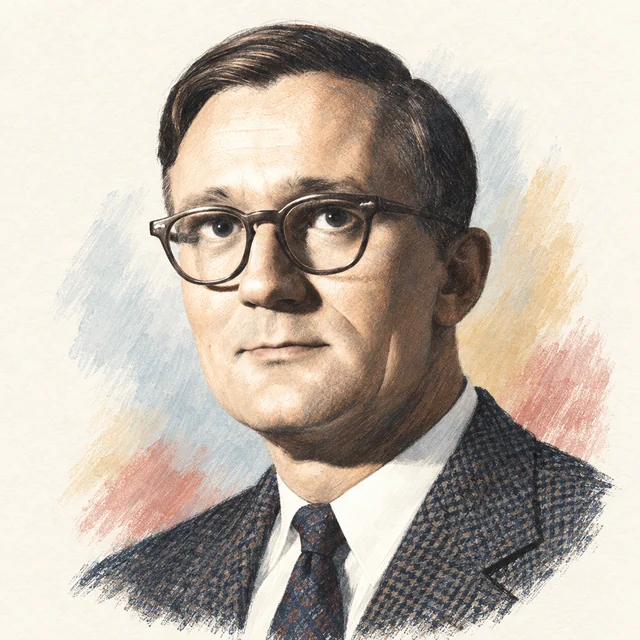
Kusch was born in Germany and moved to the United States with his family in 1912. At Case Institute of Technology his interests shifted from chemistry to physics, leading to a bachelor’s degree in 1931. Illinois awarded his master’s degree in 1933 and doctorate in 1936 after molecular-spectroscopy research with F. Wheeler Loomis. A year at Minnesota preceded his arrival at Columbia in 1937. Work with Rabi developed the use of atomic and molecular beams; wartime microwave research added important experimental methods. With H. M. Foley, he reported precise atomic magnetic measurements in December 1947 and further work on the electron’s magnetic moment in 1948. They showed a small deviation from the earlier theoretical value, important for the development of quantum electrodynamics. He became Columbia professor in 1949 and received half of the 1955 prize. His measurement and Lamb’s hydrogen work were separate experiments with related implications, rather than one joint measurement.
The contribution
Kusch determined the electron’s magnetic moment with high precision, with Foley contributing to the experiments, and established its small anomaly relative to the earlier prediction. He received one half of the Physics Prize.
The idea in plain language
How accurately did the existing quantum description match atoms? With Robert C. Retherford, Lamb used microwave methods to investigate hydrogen. Their August 1947 report established that two states expected to coincide in the earlier Dirac description actually had slightly different energies. The Lamb shift became a demanding test for a theory including the interaction of matter with the electromagnetic field.
Read the full award story ↗