A life in context
The person behind the prize
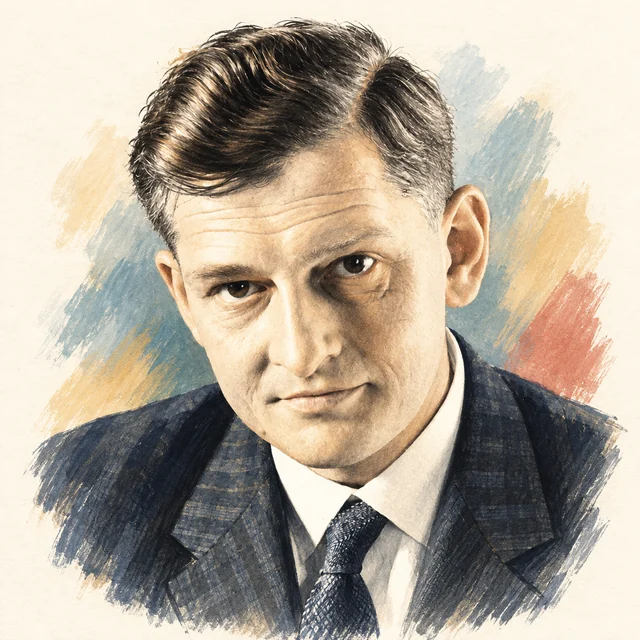
Kuhn studied chemistry in Vienna and Munich and completed his doctorate under Richard Willstätter in 1922. At ETH Zurich from 1926 he investigated molecules with conjugated double bonds, asking how structure related to properties such as colour. In 1929 he moved to the chemistry institute within the Kaiser Wilhelm Institute for Medical Research in Heidelberg; he became director of the wider institute in 1937 and also held a university professorship. His school advanced the separation and structural study of carotenoids, identified another carotene isomer in 1933, and investigated vitamins including riboflavin, B2, and B6. The 1938 Chemistry Prize was reserved, then awarded to him in November 1939. Nazi authorities forced him to decline it; he received the medal and diploma in 1949. The institute’s historical account also records his 1936 denunciation of Otto Meyerhof for employing Jewish staff and his involvement in wartime chemical-weapons research. A forced refusal of the prize therefore should not be read as evidence of opposition to the regime. His award-era institute is named here as Kaiser Wilhelm, rather than by its later Max Planck name.
The contribution
Kuhn received the whole Chemistry Prize for work on carotenoids and vitamins, including separation, structural elucidation and relationships between molecular structure and properties. His collaborators and parallel researchers also contributed.
The idea in plain language
A brightly coloured natural extract may contain several related compounds. Its appearance alone does not tell a chemist which molecules are present or how they are arranged. Kuhn investigated conjugated molecules and the relationship between chemical structure and physical properties. His school’s improvements to chromatographic methods helped separate carotenoids so that individual substances could be studied.
Read the full award story ↗

