01 · The discovery
The idea, in everyday language
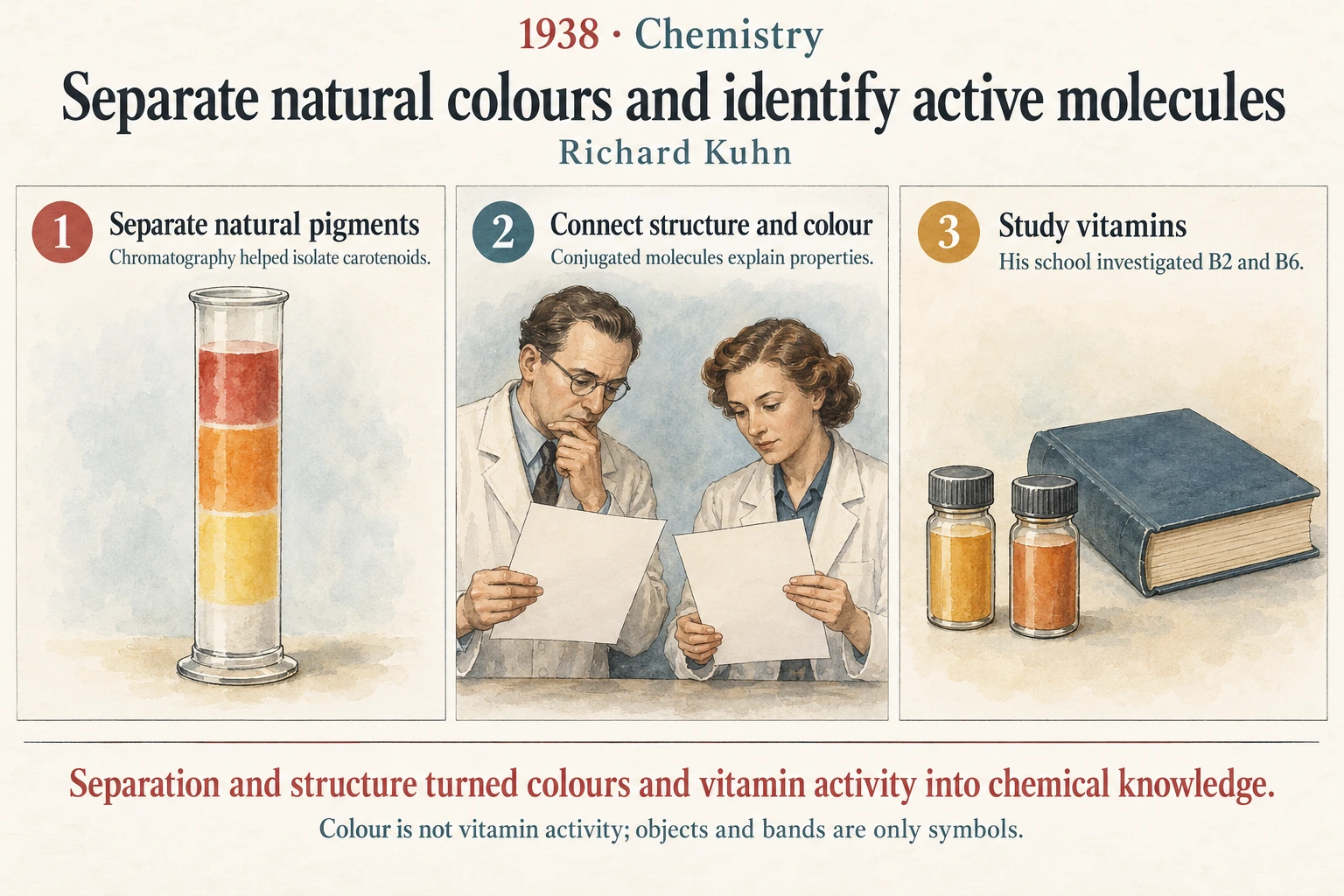
A brightly coloured natural extract may contain several related compounds. Its appearance alone does not tell a chemist which molecules are present or how they are arranged. Kuhn investigated conjugated molecules and the relationship between chemical structure and physical properties. His school’s improvements to chromatographic methods helped separate carotenoids so that individual substances could be studied.
The programme established structures and distinctions among natural pigments, including another carotene isomer in 1933. It also extended into vitamins. Kuhn, Szent-Györgyi, Wagner-Jauregg and other investigators contributed to riboflavin, or B2, research; Kuhn and collaborators studied B6 as well. These were related examples of chemical identification, not evidence that all coloured compounds were vitamins or that every carotenoid had the same biological activity.
Why it matters
The work made natural-product research more precise: separation, structural analysis and synthesis could connect an observed property with a defined chemical substance. Some carotenoids can serve as vitamin A precursors, but that does not apply to every carotenoid. B2 and B6 are different vitamins, and colour alone does not establish nutritional activity.