A life in context
The person behind the prize
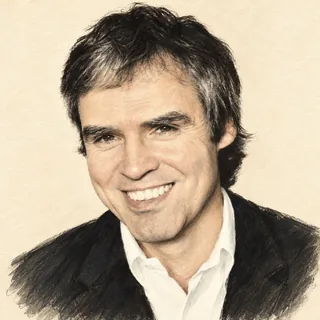
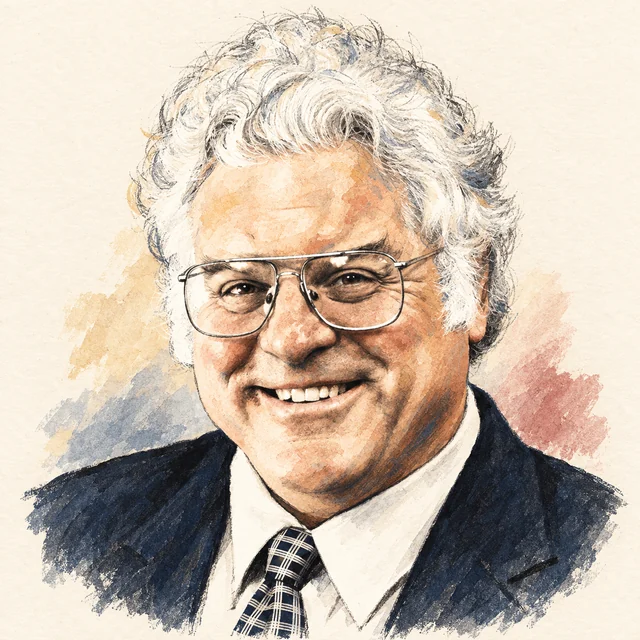
Laughlin grew up in California, where building things and exploring mathematics shaped his early interests. He studied at Berkeley and earned his doctorate at MIT in 1979. Work at Bell Laboratories brought him into contact with the experimental puzzles of electrons confined to a thin layer. He later joined Stanford. His research asked how interactions between many particles can produce behaviour that cannot be understood by treating each particle separately.
The contribution
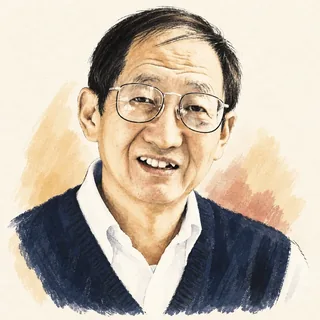
In 1983 Laughlin proposed a correlated quantum state explaining the fractional quantum Hall effect observed by Störmer and Tsui. His theory described an incompressible electron fluid whose collective excitations carry fractions of an electron’s charge. These excitations are quasiparticles of the many-electron state; the theory does not require an isolated electron to break into smaller elementary particles.
The idea in plain language
Electrons confined to a nearly two-dimensional layer behave in unexpected ways under strong magnetic fields and very low temperatures. Earlier measurements had found integer quantization of the Hall response. In 1982 Störmer and Tsui, with collaborators, observed plateaus associated with fractional filling of the electronic states. The pattern could not be explained by treating the electrons independently.
Read the full award story ↗