A life in context
The person behind the prize
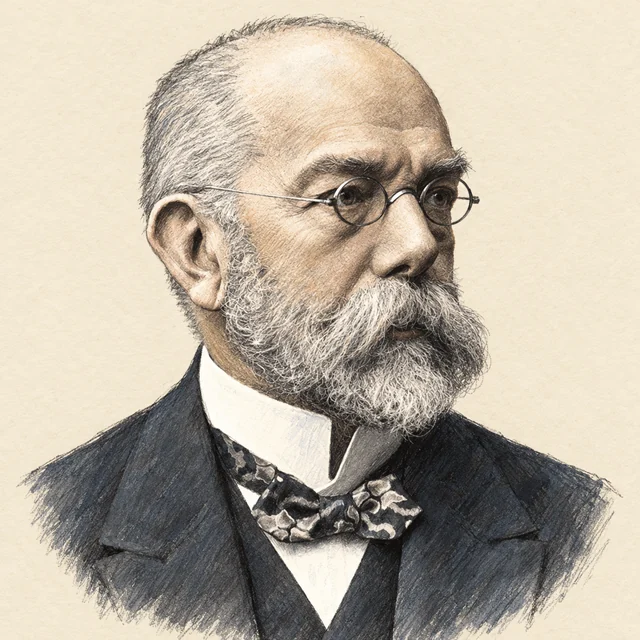
Robert Koch studied medicine at Göttingen and completed his doctorate in 1866. After work as a physician and service during the Franco-Prussian War, he became a district medical officer at Wollstein in 1872. Alongside clinical duties he investigated anthrax, establishing evidence in 1876 that a particular bacterium caused the disease. Earlier investigators had already observed the organism; Koch’s contribution concerned the chain of causal evidence and the study of its development. Moving to the Imperial Health Bureau in Berlin in 1880 gave him a setting to refine microscopy, staining and methods for distinguishing microorganisms. On 24 March 1882 he presented his evidence for the bacterium responsible for tuberculosis. The discovery joined careful observation with attempts to establish that the organism was a cause rather than a by-product of disease. Colleagues and students helped develop the laboratory methods and research school. Koch also investigated cholera in Egypt and India in 1883–1884; Filippo Pacini had described its bacterium in 1854 and deserves earlier credit. In 1885 Koch became professor of hygiene in Berlin, and in 1891 director of the Institute for Infectious Diseases, which he led until 1904. His announced tuberculosis remedy, tuberculin, failed to deliver the hoped-for cure and harmed patients; its later diagnostic role was different. The full 1905 Medicine Prize recognised investigations and discoveries concerning tuberculosis. Later work also demands ethical scrutiny. During the 1906–1907 sleeping-sickness expedition in East Africa, treatment with the arsenic-containing drug Atoxyl caused serious harm, including blindness in some people. The Robert Koch Institute describes that colonial medical research as ethically unacceptable. Koch died in Baden-Baden in 1910. A responsible account preserves the importance of his bacteriological evidence while examining mistaken therapeutic claims, collaborators’ contributions and the people harmed by his research.
The contribution
Koch received the full Medicine Prize for investigations and discoveries concerning tuberculosis. His 1882 work established evidence for its bacterial cause; identifying the cause did not itself provide a cure.
The idea in plain language
In 1882 Koch presented evidence for the tubercle bacillus as the cause of tuberculosis. Improved microscopy and ways of distinguishing microorganisms helped him connect a particular organism with a particular disease, rather than treating every visible microbe as equivalent.
Read the full award story ↗