c.curionodeThe Nobel Archive

1905 · Physiology or Medicine

Establish a bacterial cause of tuberculosis

Finding bacteria in diseased tissue does not by itself show what caused the disease. Koch’s tuberculosis research joined observation with a systematic search for causal evidence.

TuberculosisBacteriologyCausal evidence
1905Physiology or Medicine

Visual guide

The prize, pictured

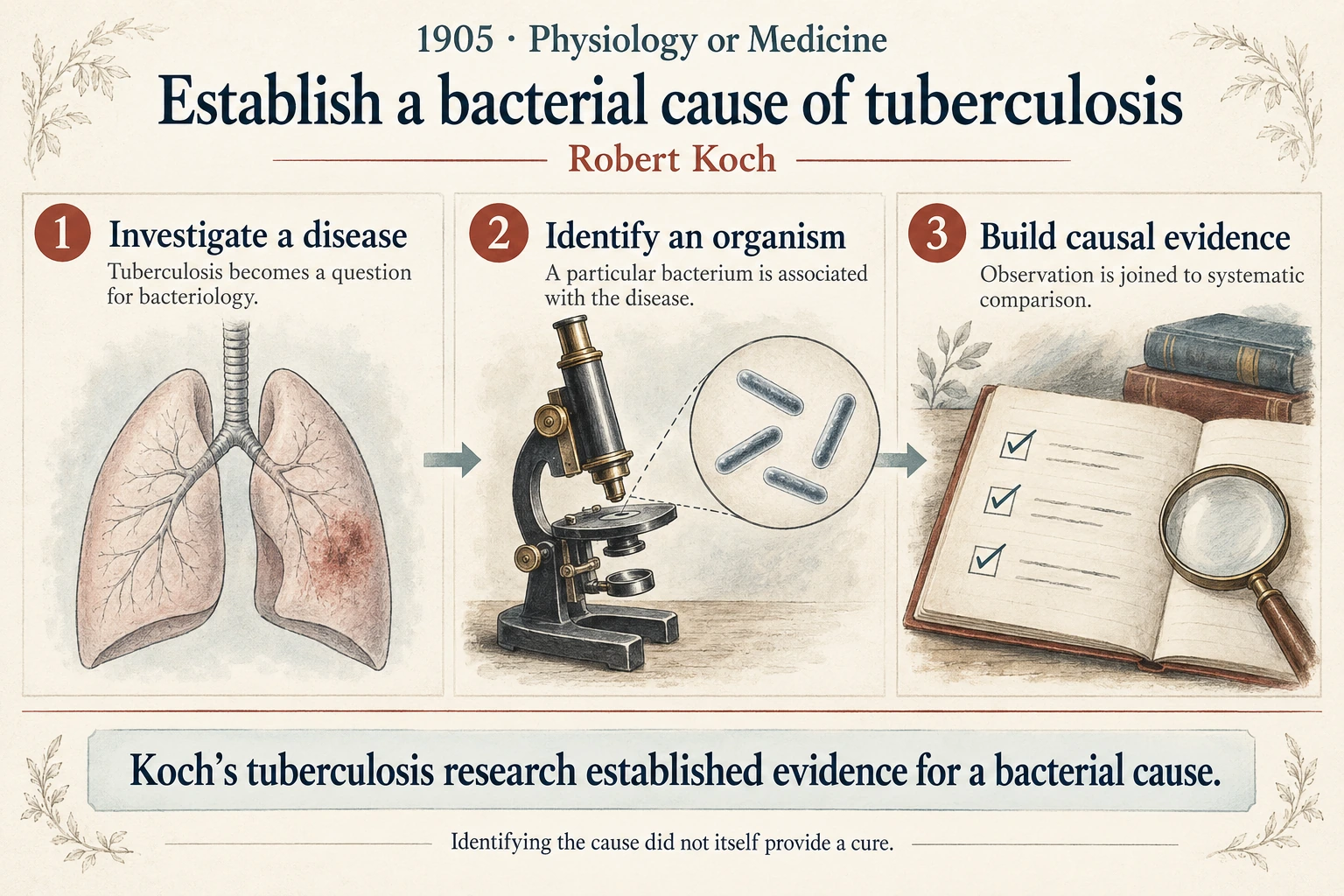
Infographic explaining Establish a bacterial cause of tuberculosis
Original AI-generated infographic. A conceptual overview; the explanations and sources below provide context.
Read the poster text

Koch’s tuberculosis research established evidence for a bacterial cause.

  1. Investigate a disease

    Tuberculosis becomes a question for bacteriology.

  2. Identify an organism

    A particular bacterium is associated with the disease.

  3. Build causal evidence

    Observation is joined to systematic comparison.

Identifying the cause did not itself provide a cure.

01 · The discovery

The idea, in everyday language

In 1882 Koch presented evidence for the tubercle bacillus as the cause of tuberculosis. Improved microscopy and ways of distinguishing microorganisms helped him connect a particular organism with a particular disease, rather than treating every visible microbe as equivalent.

The work drew on methods developed within a growing research community and opened a programme for investigating tuberculosis. The full 1905 prize specifically recognised investigations and discoveries concerning this disease, within Koch’s wider bacteriological career.

Why it matters

Identifying the bacterial cause made tuberculosis an experimentally investigable infection and helped direct later research and public-health measures. It was a foundation for further work, rather than an immediate cure.
02 · The people

Who brought the idea to life?

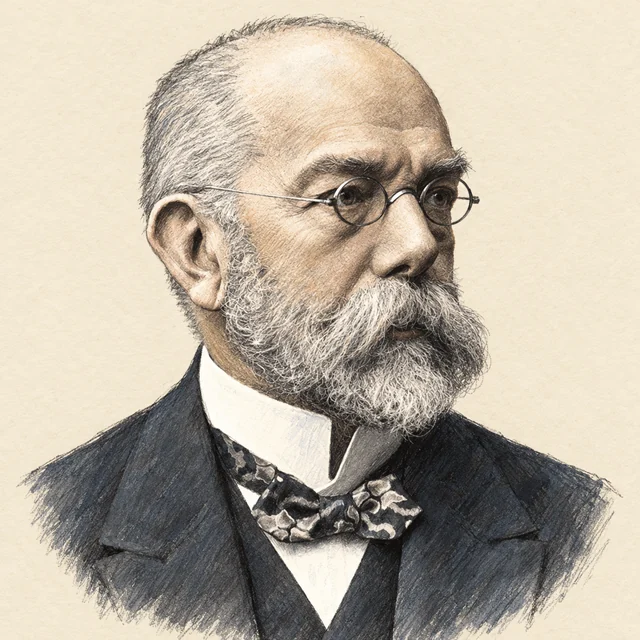
Illustrated portrait of Robert Koch

Robert Koch

Prize share · 1

Koch received the full Medicine Prize for investigations and discoveries concerning tuberculosis. His 1882 work established evidence for its bacterial cause; identifying the cause did not itself provide a cure.

Read the biography ↗

03 · Years in the making

The path here

  1. 1866

    Koch completes his medical doctorate.

  2. 1872

    He becomes district medical officer at Wollstein.

  3. 1876

    His anthrax research establishes a chain of causal evidence.

  4. 1880

    He moves to the Imperial Health Bureau in Berlin.

  5. 1882

    On 24 March he presents evidence for the tuberculosis bacterium.

  6. 1890

    The proposed tuberculin cure fails to fulfil its promise.

  7. 1891

    He becomes director of the Institute for Infectious Diseases.

  8. 1905

    The Medicine Prize recognises tuberculosis research.

04 · Read further

From the original sources

Original explanations by Curionode, based on the official records below. Biographical details and affiliations refer to the award year.

  1. Official award summary nobelprize.org
  2. Award ceremony speech nobelprize.org
  3. Robert Koch Institute: Koch’s research and its limits rki.de
  4. Robert Koch Institute: confronting colonial medical research rki.de

More in Physiology or Medicine

Browse this subject ↗