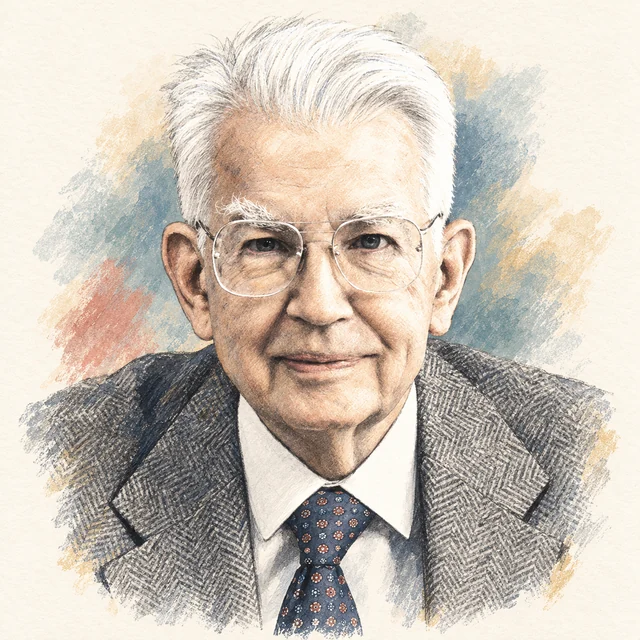
A life in context
The person behind the prize
Coase studied commerce at the London School of Economics, where Arnold Plant’s teaching changed his understanding of coordination through prices. Visits to American factories and businesses in 1931–1932 prompted the question of why firms exist. After teaching and research in Britain he moved to the United States in 1951. At Chicago from 1964 he edited the Journal of Law and Economics and encouraged studies of how actual markets and institutions operate.
The contribution
Coase explained that organising exchange takes resources: finding partners, negotiating agreements and enforcing them. The Nature of the Firm examined why coordination within a firm can sometimes save those costs. The Problem of Social Cost made rights and the costs of bargaining central to studying conflicting uses of resources. His analysis asks how alternative institutions work under real conditions, rather than assuming that markets or government always offer the best arrangement.
The idea in plain language
If prices can coordinate exchange, why do firms organise so much activity internally? Coase asked what using a market actually costs: searching for partners, negotiating agreements and checking that they are carried out. A firm can replace some separate bargains with internal direction, but management also has costs. Its boundaries depend on comparing these ways of organising activity.
Read the full award story ↗