A life in context
The person behind the prize
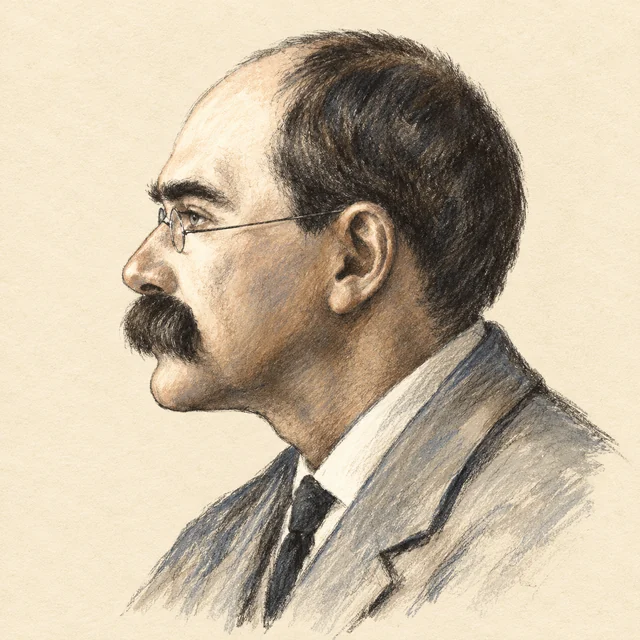
Rudyard Kipling was born in Bombay, now Mumbai, and spent his early childhood in British India. Sent to England in 1871, he later attended the United Services College before returning to India in 1882 to work for the Civil and Military Gazette in Lahore. Journalism trained close observation and concise storytelling, while his position in colonial society shaped both the range and the limits of what he saw. Departmental Ditties appeared in 1886 and Plain Tales from the Hills in 1888; collections of soldiers’ stories helped establish his reputation. His writing ranged across poetry, short fiction, novels and stories for children. The Jungle Book of 1894 and its 1895 sequel were followed by works including Captains Courageous, Kim and Just So Stories. Different voices, compressed situations, rhythm and imaginative transformations gave his narratives a readership far beyond one genre. In 1902 he and his wife Caroline bought Bateman’s in Sussex, where he wrote Puck of Pook’s Hill and later works; Carrie also managed the estate. Awarded the full Literature Prize in 1907, he was forty-one at the December ceremony and became its youngest recipient. Recognition concerned his broader authorship, rather than a prize for one children’s book. His public support for British imperialism and the racial hierarchies present in parts of his writing are essential to a critical reading of that achievement. During the First World War he supported the British war effort. The death of his daughter Josephine in 1899 and the loss of his son John at Loos in 1915 also marked the family and his later writing. Kipling died in London in 1936. His literary resourcefulness and his imperial politics remain connected parts of a complicated legacy.
The contribution
Kipling received the full Literature Prize for observation, imaginative originality and narrative power across a broad authorship of stories and verse.
The idea in plain language
Journalism and life in colonial India supplied much of the material for early short stories. Kipling compressed a setting, a distinctive voice and a conflict into narratives that could suggest a larger world beyond the page. Verse added rhythm and memorable speech; stories for children used transformations, animals and playful explanations to open different imaginative possibilities.
Read the full award story ↗

